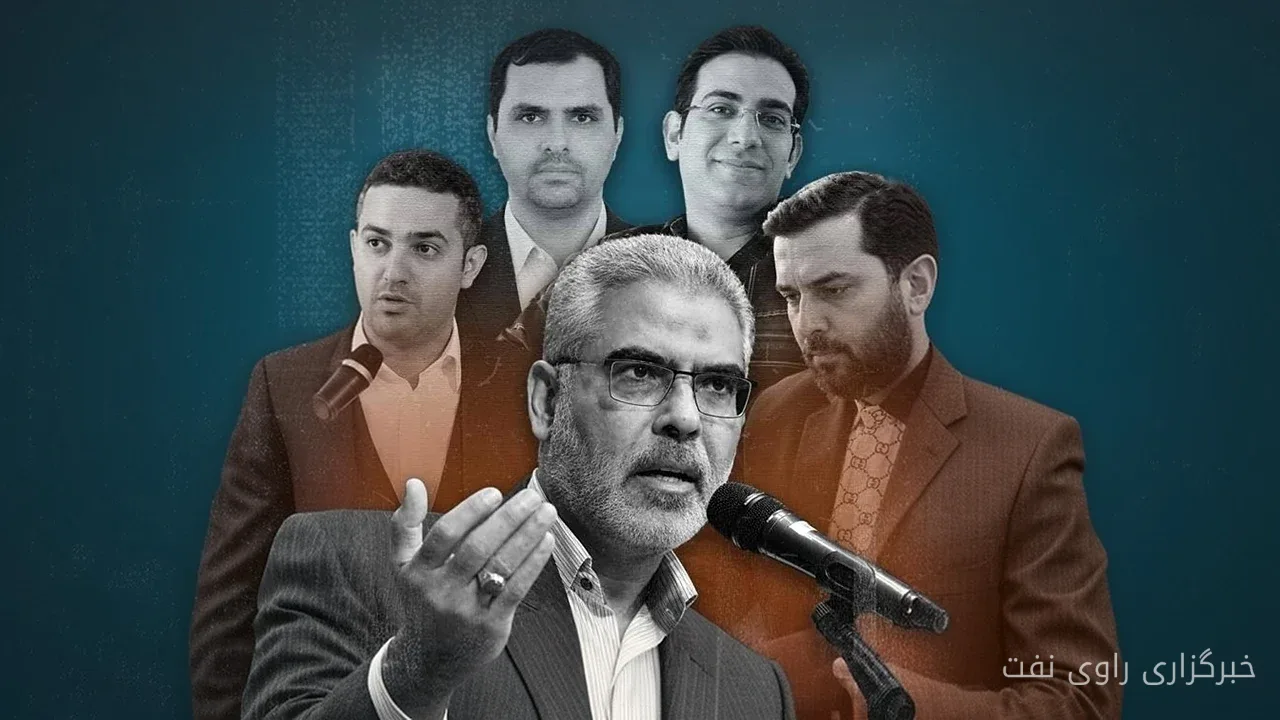
Based on these notes, three people — Razavi, Momeni, and Bayandarian — gathered around a table at the 'Charlie' restaurant in Dubai and explicitly stated their intention to spend large sums of money to bring about the destruction of Iran and not return billions of dollars from oil resources that they have obtained 'unjustly'; simultaneously, Hossein Samasami, a representative who presents himself as an anti-corruption supporter, rises to defend this very trust and, by weaving a narrative about 'the squandered 11 billion dollars of oil money', covers up the deficiencies and corruption. This event was recorded at a moment when the people of Iran are enduring a 40-day war under bombs and shells.
The scene is clear: a glossy table, soft yellow light, glasses swirling with ice, and three key oil figures sitting together. Based on these notes, at the same hours when houses in Iran are shaking and families are rushing to shelters, these three have planned an agenda in Dubai: spend large sums, keep the propaganda machine running, and ensure that whatever should return to the country's treasury does not.
Read more: Investigation of Unusual Activities in the Oil Market by the Commodity Futures Trading Commission
Gathering at 'Charlie' Dubai: Three Names, One Decision
Razavi, Momeni, and Bayandarian — three names identified in these notes as key figures of a corrupt trust — gathered in Dubai. Their chosen venue, 'Charlie', is not just a luxury restaurant; it is an open scene of synergy to advance a common goal that is explicitly stated in these notes: 'Spend money to destroy Iran', while simultaneously ensuring that no amount of the 'billions of dollars' of oil resources they have 'unjustly' taken returns to the country.
The message of this gathering is clear: practical solidarity to disregard the people and the public treasury. When the three sides of this trust sit at the same table, it signifies joint decision-making; a division of roles among money, media, and influence. There is no sign of retreat here; rather, the question arises: what mechanism should prevent the transfer of national resources to private tables when its designers announce such an unambiguous goal?
The Billions that 'Must be Returned' and the Will Not to Return
These notes emphasize that the core of the trust's agenda is clear: resistance against returning 'billions of dollars' from oil resources that have been 'unjustly' obtained. This statement means a clear demarcation between public interests and the interests of a gang. Every dollar that remains in these accounts is deducted from public services, from the rights of workers and teachers, from medicine and infrastructure. If these three names sit together to solidify this 'not returning', the result is not just a fatter bank account; it is a chain of shortages that intertwines with the daily lives of the people.
One must ask: which contract, which transfer, and which channel has diverted these 'billions' from the path back to the treasury? Who has paved the way, who has turned a blind eye, and who benefits from this blindness? The notes name names and clarify intentions; now it is time for accountability.
A Representative Labeled 'Anti-Corruption' and His Position Next to the Trust
The next point in these notes is the entry of Hossein Samasami: a representative who presents himself as an anti-corruption supporter but rises to defend the trust. This contradiction is not just a verbal conflict; it is a blow to public trust. When someone enters the scene under the banner of fighting corruption and then stands in defense of the three sides of a gang, it is serious: the bastion of law has become a shield for justification.
These notes clearly state that Samasami, by 'weaving lies about the squandered 11 billion dollars of oil money', conceals deficiencies and corruption. This means a targeted narrative construction: diverting public attention with a large and exciting number so that the main question is not seen — the same 'billions' that must return. When the narrative becomes a shield, instead of enlightening, it creates smoke; and smoke blinds the eyes of the people.
The '11 Billion Dollar' Scenario: A Number to Cover a Hole
At the heart of this game, one number shines: 11 billion dollars. Based on these notes, this number is a tool, not news. A tool for concealment; a narrative intended to draw all attention to a 'super lost' so that the main question is avoided: 'Why are the funds unjustly taken from oil resources not being returned?' When the large number becomes a shield, it wins the battle of minds. However, the accounting of the state-nation is measured not by noise but by deposit slips and the accumulation of public capital.
If 11 billion dollars have 'gone to waste', show the list of the path of the wind. If not, why are you spreading this dust in the air? A clear answer is required: name, number, date. Anything less than this is just smoke; the same shield that serves the trust.
The 40-Day War and the Dubai Feast: Two Images, One Result
In these notes, a painful contrast is recorded: a 40-day war and a feast in Dubai. On one side, people under bombs and shells; on the other side, three trusts writing plans for a dark future in a safe and luxurious restaurant. Let’s place these two images side by side to understand why the people's anger boils. When houses collapse, every banknote that should reach medicine, housing, and reconstruction, if it remains in dark accounts, shows its result on every table.
This is not an accidental symmetry; it is a sign of the geometry of power and money. What is being arranged at 'Charlie' Dubai is directly connected to the line of bread and medicine in Iran; with a simple question: will those 'billions' be allocated to media styling and lobbying instead of the treasury, so that their return path is forever closed?
Unanswered Questions that Now Demand Answers
The list of questions in the notes is clear, and the people are asking the same: why does Hossein Samasami — labeled 'anti-corruption' — become a shield for a trust? Is the position of representation meant to hold trusts accountable or to justify them? If a narrative about 11 billion dollars is being woven, where is the row of documents, and why does this narrative obscure the path of accountability from Razavi, Momeni, and Bayandarian?
A more explicit question has also been raised: what benefit has Samasami gained from this line of defense? How much money from the trust gang of Razavi, Momeni, and Bayandarian has reached him to keep the truth hidden? These are direct questions from the public. The answer must have numbers and dates. Silence is the same as confirming the scenario.
Related Footprints in This Case: From Exploration to the Energy Commission
These notes are not limited to just one table in Dubai; they also mention the '230 million dollar corruption of Mohammad Salehi Dolabi in the oil exploration operations company' and highlight a conflict: 'The dispute between Ali Mousa Ahmadi and Ahmad Midari over extortion in the Energy Commission'. These are other pieces of the same puzzle: the diversionary paths of money, from operational companies to power rooms in the parliament. When the pieces sit together, a unified image emerges: a network that has taken public interests hostage from exploration to the commission, from restaurant to podium.
The public has the right to follow these connections. Each piece of this case illuminates a path: who decided, where was it signed, what transfer occurred, and who should answer. Wherever money moves, there are traces of decisions and signatures. These footprints must be clarified one by one with names, numbers, and dates.
What the People See: Concealment, Not Reform
The people of Iran are not only faced with numbers and names in these notes; they also share a common feeling: that those who should stand against corruption are standing behind it. When a representative with the slogan of fighting corruption takes on the role of a shield for a trust, the message is clear: the legislative institution is reflected in the mirror of darkness instead of transparency. This is the moment when trust collapses; and without trust, no reform lasts.
The people have a simple expectation: the return of money to the treasury, cutting the hands of gangs from oil resources, and a podium that puts the truth on the table instead of deceiving with numbers. This expectation is a right, not a privilege.
The Final Demand: Name, Number, Path
Now that the outlines based on these notes are clear, the final demand is also simple and precise: announce the names of individuals, the amounts transferred, and the paths of money going back and forth. If 'billions' are involved, specify the time and choke points. If plans have been made in a restaurant in Dubai for the destruction of Iran and 'not returning' the money, piece together each element of that map. Anything less than this is a continuation of the same concealment.
Why This News is Important
This news is important because in the midst of a 40-day war, three sides of an oil trust — Razavi, Momeni, and Bayandarian — based on these notes sat together and wrote a plan that is directly connected to the people's table: spending large sums to lock the return of 'billions of dollars' to the treasury. The second importance is the entry of Hossein Samasami as a representative labeled 'anti-corruption' who has taken on the role of narrative shield in these notes: the scenario of '11 billion dollars squandered' has become a tool for covering up the real paths of corruption instead of clarifying.
The weight of this news is measured in three axes: one) time and context — the simultaneity of the Dubai feast with bombs and shells over the people. Two) chain of effect — every unreturned dollar is directly deducted from public services and livelihood security. Three) institutional equation — when a representative justifies instead of pursuing, public trust collapses and the way for repeating the pattern remains open.
These notes do not just record a gathering; they show a pattern of action: sitting in a safe restaurant, determining the dominant narrative, injecting money into influence networks, and locking the path of resource return. If this pattern remains unanswered, it will be repeated tomorrow with different names and tables. Therefore, the importance of the matter is summarized in a demand that the people now voice loudly: announce the names, reveal the numbers, open the paths — and let the oil money return to the public treasury instead of private tables.
Finally, this news is important because it places the main question in the middle of the field: who signed, what was transferred, and who should answer. As long as these three answers do not come, any other narrative — no matter how noisy — will be nothing but smoke to hide the fire of corruption.
Read more: Selection of RSGT as the Operator of the Chittagong Container Terminal