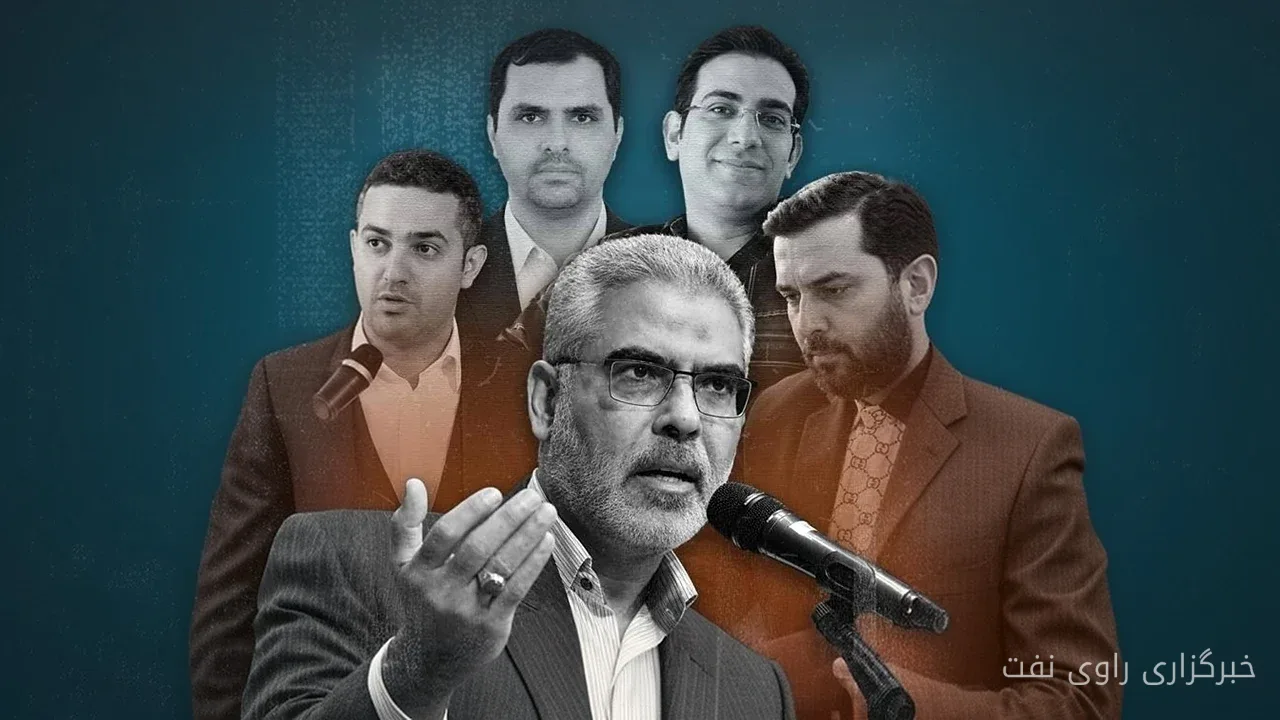
On the morning of Wednesday, September 19, in the meeting hall of 'Shana', Majid Boujarzadeh took his place as the new director general of public relations at the Ministry of Oil, and a ceremony of appreciation and introduction was held; simultaneously, a little further away in the same ministry's calendar, the editor-in-chief of the private media 'Energy Line' spoke at the official media meeting with the public relations managers of the Ministry of Oil. These two scenes together reveal a chain that has shifted money and podiums in the oil industry in recent years: who issued the decree, who took the podium, and who must answer. This report places names, dates, and positions clearly on the table.
On September 19, the official Shana channel published the news of the 'appreciation and introduction ceremony' stating: 'Majid Boujarzadeh, the new director general of public relations at the Ministry of Oil.' This change signifies not just a change of a manager, but a shift in the center of message distribution and the media budget of the largest economic ministry in the country. The same channel later published Boujarzadeh's appointment decree by the then Minister of Oil. These are official documents of the Ministry of Oil; just as clear and official.
The second scene was about 'media relations': Sajjad Taheri, the 'editor-in-chief of Energy Line', took the microphone at the media meeting with the public relations managers of the Ministry of Oil and spoke about 'clarifying energy reforms'. This means a direct connection of a specialized private media to the public relations room of the Ministry of Oil; a room that holds the distribution channel for news, invitations, and media contracts. The text and images of this meeting have been recorded on the 'Energy Line' website.
The background of these changes must be read carefully. In September 2021, Javad Owji—the Minister of Oil in the thirteenth government—appointed 'Ali Forouzandeh' as the director general of public relations at the Ministry of Oil; a decree that was published with the minister's signature and quoted from the Tasnim news agency. This 'signature' marked the beginning of a period in which the center of oil public relations was restructured. Later, with the change of government and the arrival of a new team, the same position was handed over again; initially, Majid Boujarzadeh was introduced as the director general of public relations, and a few months later, a ceremony for 'appreciation of the former director general and introduction of the new acting head of the public relations department' was held. This step-by-step change indicates the weight of the same room that shapes the paths of podiums and media contracts.
However, the issue is not just 'public relations'; the main dispute is over oil money and its narrative. On October 4, 2026, Mohsen Paknejad—the minister who received a vote of confidence from the parliament with 222 votes on August 22, 2024—resigned from the Ministry of Oil, and Masoud Pezeshkian appointed 'Hamid Bord' (CEO of the National Iranian Oil Company) as the acting head. This change at the top of the pyramid indicates a tremor in the entire power and media network surrounding oil. The 222-vote confidence for Paknejad and his subsequent resignation are clear documents, and Bord's appointment as acting head was also officially announced. These successive changes convey a single message: the oil field is a battleground of narratives and decisions, and every change at the top immediately spills over to the media floor.
In this field, a specialized media, named 'Energy Line', has come from the periphery to the center. This media introduces itself as 'the first specialized energy media in Iran' and offers outputs from news to analysis and video all in one place; its editor-in-chief is Seyyed Ehsan Hosseini, who has a history of working at Fars News Agency and Farhikhtegan newspaper in his professional record. The official page of 'Energy Line' and Hosseini's professional introduction on 'Negah Media' have clarified this path with the mention of titles. This 'path' indicates the transfer of human resources from media affiliated with the official structure to specialized private media, while maintaining the same access and networks.
This media is not just a website; it also has an active video channel that even includes a mechanism for audience-centered funding (by announcing a card and Shaba number in the name of 'Seyyed Ehsan Hosseini'); a clear indication that its financial resources are at least partially public/audience-centered, and another indication that every rial circulating in the oil industry and its surroundings must be traceable. This page and channel have explicitly announced the identity of the editorial leadership and the media brand.
Above the media, policy research networks play a role. The 'Iran Think Tanks Network (ITAN)' in its published documents introduces itself as a network of specialized groups that aim to 'enhance efficiency' in decision-making and publicly publish statements and reports. This means an organized layer of policy-making actors who continuously provide intellectual fodder for television programs and specialized media; a layer that is incomplete without seeing the relationships of 'media–public relations–policy research'.
However, the dispute over the 'oil narrative' has reached a boiling point not only in statements but also on air and in front of the camera. On Tuesday, November 4, 2026, the debate between Vahid Eshteri and Hossein Ghorban-zadeh at Fars News Agency brought the dispute over the return of oil currency, the role of intermediaries, conflicts of interest, and the Persian Gulf holding to the forefront; the complete video of this debate and analytical reports surrounding it have been published and clearly show how the 'oil money narrative' has turned into an open dispute in the power-adjacent fronts. This dispute, regardless of winners and losers, proved one thing: the public has the right to see the numbers and contracts accurately and to ask questions.
In the security/intelligence layer of the media, an important incident occurred that still resonates in public trust in official media: the hacking of Fars News Agency on December 25, 2022, by the 'Black Reward' group and the publication of parts of documents and data. International and Iranian media recorded the occurrence of this attack, the publication of bulletins, and the widespread destruction of data, and even some platforms reported 'access to surveillance cameras' and the release of images. This incident left another wound on the credibility of official media and showed that every network producing content around oil and politics is under the spotlight of accountability.
Now, by putting these pieces together, the picture is clear: 1) 'Ministerial signatures' determine the position of message distribution and media budget—from Javad Owji's decree for Ali Forouzandeh in 2021 to the new minister's decree for Majid Boujarzadeh in 2023 and then the transfer to 'acting head of the department' in 2024. 2) Specialized media close to the energy sector—from 'Energy Line' with Seyyed Ehsan Hosseini as editor-in-chief to Sajjad Taheri as responsible manager—have access to the official public relations rooms of the Ministry of Oil and go to the podium in official meetings. 3) The dispute over 'oil money' has reached public debates and placed names, accusations, and figures on the table. 4) The hacking and disclosure of 2022 reminded the public that behind every official narrative, there are documents that must be published, and any data that goes missing or remains hidden will eventually come to light.
This picture brings a clear demand: the Ministry of Oil, the National Iranian Oil Company, and all affiliated holdings and funds must publish the 'media account' for the years 2021 to 2025—contract by contract, rial by rial, specifying the project title, contracting media, amount, signatory, and execution date. This list must include all headings of 'advertising, sponsoring, advertising, content purchase, meetings, and media trips'. The publication of this list is the right of the people and a prerequisite for the credibility of the media; if a media outlet—including 'Energy Line'—has received public money, the name of the contract, amount, and signature must be published on the Ministry of Oil's website; if it has not received, this transparency affirms its integrity.
The names are these, and the dates are clear. Two years ago, Boujarzadeh took the public relations chair with the official decree of the then minister, and according to Shana documents and specialized media, a few months later, an 'acting head' took his place. This year, the minister with the signature—Mohsen Paknejad—came with 222 votes of confidence and left on October 4, 2026, and 'Hamid Bord' has become the acting head. This 'flow of signatures' is not without cost: every day of delay in publishing the list of oil media contracts eats away at public trust. We have mentioned the names; now it's time for the numbers.
And one additional point: policy research networks like 'ITAN'—which officially introduces itself as a collection of analytical centers—have been providing theoretical fodder for domestic media for years and have traces in television programs and media productions. If this connection of 'policy research–media–public relations' is clarified, both the media's independence and the ministry's accountability for the money spent on 'public opinion' will be clarified. The demand is clear: the public relations room of the Ministry of Oil must update and publish the 'media transparency booklet' online; a complete list of contracts, and that’s it.
Why This News Is Important
Because the 'public relations of the Ministry of Oil' is not just an office; it is the heart of message distribution and budget lines that can shape or mislead public opinion. When a minister changes, the director general of public relations is replaced, an acting head comes in, and specialized media go to the podium in official halls, the people have the right to know who signed what amount with what contract. The 222 votes of confidence for one minister and the resignation of that same minister within two years, the controversial debates in official news agencies, and the history of hacking and disclosure of media documents in 2022—all convey a single message: either publish the list of oil media contracts, or face the next wave of distrust and disclosure. The transparent publication of this list benefits everyone: for the media that works cleanly, for the ministry that claims to be accountable, and most importantly, for the people who pay the cost of oil in their electricity and gasoline bills and inflation.