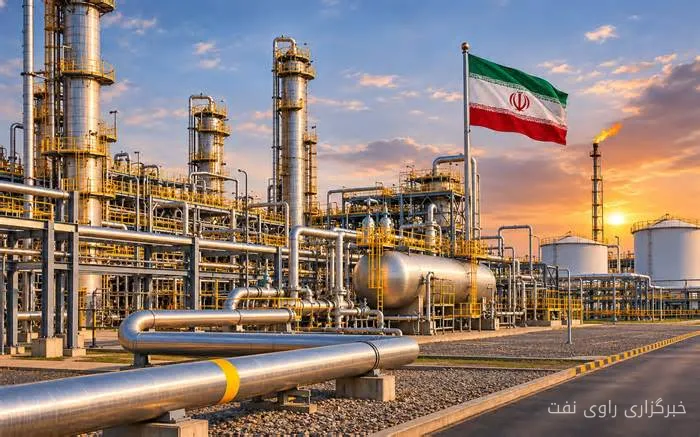
The Ministry of Oil has announced an increase in the volume of collected flare gases and associated gas, achieving a daily collection of 17 million cubic meters of gas. This gas, which had been burned for years, can be transformed into valuable resources for fueling industries and generating revenue.
Dehloran Petro-Refinery Project and Its Goals
One of the most important projects of the Ministry of Oil is the Dehloran Petro-Refinery, or NGL3100, which is defined with an investment of about 1.1 billion euros and a daily processing capacity of 240 million cubic feet of gas. This project targets the associated gases from the Cheshmeh-Khosh, West Paydar, Danan, Sarvak, Azar, and Dehloran fields and will facilitate the shutdown of 9 flares in the region.
Read more: Decrease in Brent and West Texas crude oil prices influenced by diplomatic negotiations
However, the Ministry of Oil emphasizes that the designed capacity of this processing unit should be compared with the actual amount of gas received and processed to evaluate the achievement of its goals.
Private Sector Participation and Gas Collection Capacity
Another focus of the Ministry of Oil's program is the use of private sector investment and operational capabilities for collecting associated gases. According to announced statistics, 6 work packages for collecting flare gases have been put into operation, 17 packages are currently being implemented, and 16 packages are in the contract signing stage. Additionally, 4 packages are in the transfer stage.
The capacity for gas collection in the operational packages is reported to be 78 million cubic feet daily, and with the completion of all packages, the daily collection capacity will reach 504 million cubic feet of gas. This program can help reduce gas flaring in the oil-rich regions of the south.
According to statistics, Iran ranks among the highest countries in the world in terms of gas flaring, and this situation underscores the necessity of implementing gas collection projects. However, the success of these projects also depends on the actual amount of gas being flared.
Existing Challenges and the Need for Transparent Reporting
Collecting flare gases not only helps reduce pollution but also serves as a solution to prevent energy resource waste and provide feedstock for downstream industries. The Ministry of Oil should publish detailed statistics on the volume of produced associated gases, the amount of gas collected, the volume of gas sent to flares, and the number of flares that have been shut down.
By publishing periodic and verifiable reports on project performance, the public and economic actors can be informed about the amount of gas that was previously burned in flares and know when the remaining waste is expected to stop. Ultimately, the actual reduction in gas flaring should be a criterion for evaluating the success of these projects.
Read more: A 3.2% decrease in Brent crude oil price to $109.09 · Meetings of the caretaker of the Ministry of Oil of Iran with energy ministers in Moscow



