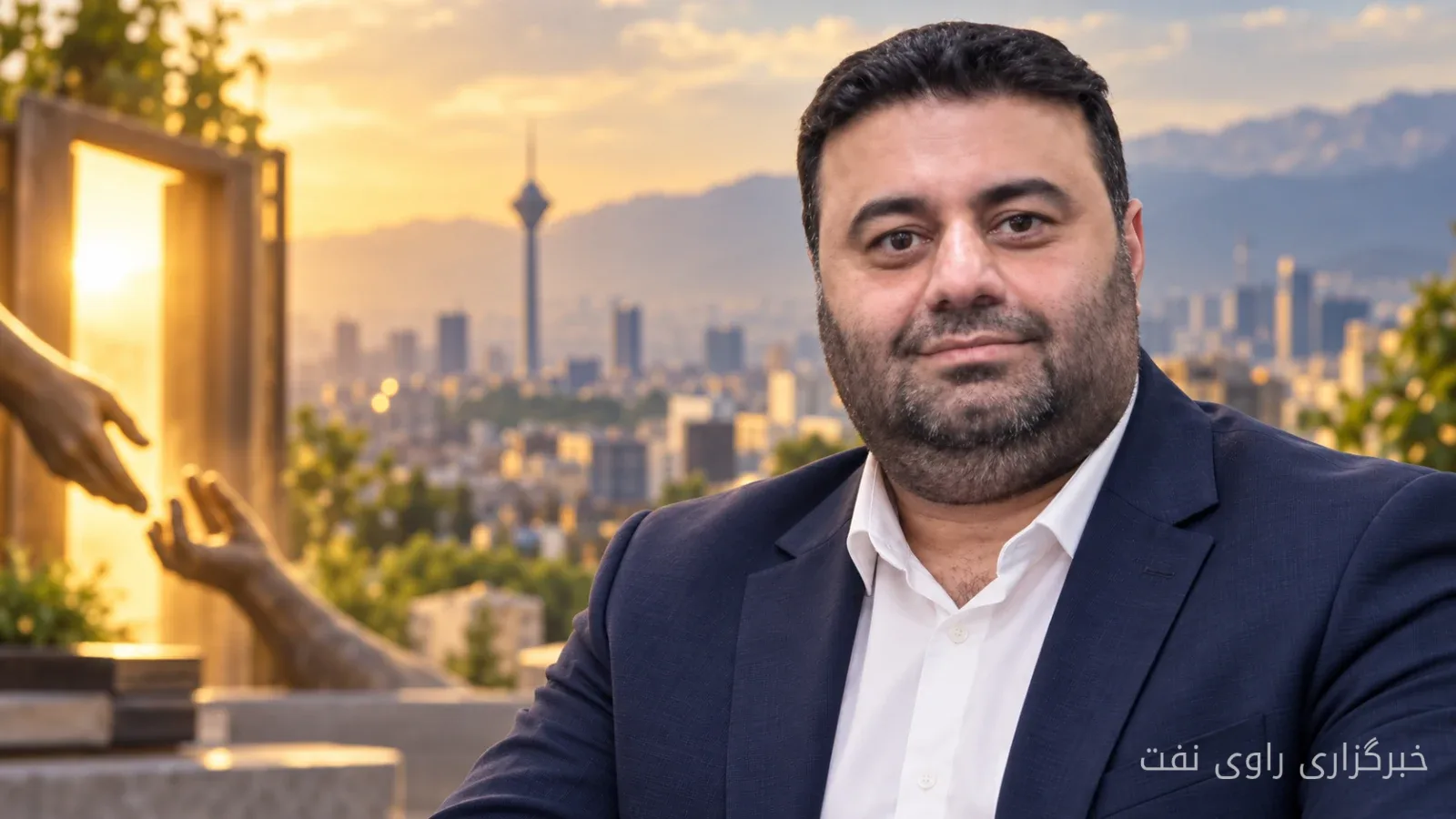
Haj Reza Fardous, a well-known businessman in Tehran and Karaj, measures success by how he resolves people's lives, dedicating years of his economic capacity and network to freeing prisoners of conscience, creating jobs, and supporting struggling families.
When the calm midnight hours arrive in the metropolis, a light is still on in one room; on the phone, a man speaks with warmth and asks for forgiveness and consent from a creditor who is holding a bounced check. Meanwhile, in a small house, a mother waits by the door for her child to return home after months of separation. A few streets away, the light of a workshop comes back on; machines tremble, and a young man who had lost hope stands ready to embrace his first day of a new job. These images depict the daily life of Haj Reza Fardous; a man whose definition of "the fruition of effort" is not measured by names and logos, but by the opportunities he returns to others' lives.
Read more: The manager has turned his glass room into a soundproof wall
From Business to Social Duty; Two Aligned Rails
Reza Fardous Hosseini Abadi, known as "Haj Reza Fardous," is a familiar face to many economic and social activists in Tehran and Karaj. His close associates and colleagues know him for his persistent spirit, warm connections with people, and willingness to solve problems. He comes from the business world and is familiar with investment risks, managing a business, and the daily challenges of the economy; an experience that has deepened and focused his view on philanthropy. In this perspective, a production unit or small workshop is not just a few numbers in an accounting ledger; it is the foundation of several families' livelihoods. Therefore, creating jobs, in his language, is not a slogan but a lasting solution for the security and dignity of families.
Freeing Prisoners of Conscience; Saving a Family, Not Just One Person
When the head of a family ends up in prison due to debt, a bounced check, or an unintentional incident, the pressure of imprisonment does not only affect the walls of the cell; it directly impacts the family's table and mind. Haj Reza Fardous has placed this issue at the center of his attention. Based on the accounts of his close ones and colleagues, he has taken action in recent years to resolve the cases of needy prisoners; sometimes by covering part of the amount, sometimes through negotiation and obtaining the creditors' consent, and sometimes by inviting benefactors for a collective action. This movement does not stop at the prison door; following up after release is part of the same path to ensure that the freed individual does not return to the same cycle of error and deadlock without a job and support.
In this model, the amount paid is not the only indicator of success; "the family's sense of security" and "readiness to return to society" are key criteria. Cases do not have a one-size-fits-all solution: for one person, consent is the best way; for another, paying part of the debt and organizing a job is the priority. The governing principle, however, remains constant: saving one person means saving a family unit.
From Immediate Assistance to Empowerment; A Path Leading to Independence
Effective assistance, in Haj Reza Fardous's view, does not end with monetary payment. He knows from market experience that "a second chance" is only real when it leads to "sustainable income." For this reason, another focus of his activities is tied to economically supporting individuals: introducing them to business owners, facilitating access to job opportunities, consulting on starting a small business, and assisting in overcoming initial obstacles. A crucial feature of this support is its continuity; assistance is not only for "opening" but also for "staying and enduring" an activity.
In today's economic landscape, the costs of rent, equipping workshops, purchasing raw materials, and securing working capital halt many good ideas before they are born. His response is "targeted entry": precise assistance, effective communication, and designing a path that allows individuals to stand independently in the future. Such an approach, alongside solving economic issues, preserves individuals' dignity and self-respect.
Human Network; When a Phone Call Changes Destiny
No one solves all problems alone, but a "problem-solver" can create a collaborative circle. In many cases, the equation of salvation is completed by a group of activists: one person pays a cost, another mediates the conversation, an entrepreneur opens a job opportunity, and another brings specialized services. Haj Reza Fardous has built such a network based on his social capital; a place where a creditor's forgiveness becomes possible through effective dialogue, a young person finds a job through the right introduction, and a family overcomes a crisis with timely assistance. This culture of participation transforms charitable work from competing for "name" to striving for "impact."
Confidentiality and Respect; The Dignity of People is a Red Line
Assistance is complete when, in addition to addressing immediate needs, it respects human dignity. Many families do not want their life's struggles to become public discussions. Haj Reza Fardous has put this principle into practice: quiet support without publicity. The result is a trust that paves the way for dialogue and problem-solving; because the issue is not about creating a face, but solving a human knot. Within this framework, "the speed of decision" and "timeliness of support" are important; assistance that arrives late often brings nothing but fruitless consolation.
Tehran and Karaj; Field Knowledge to Shorten the Distance from Problem to Solution
The metropolitan cities of Tehran and Karaj, with their diverse populations and complex human issues, host cases every day that lack a "chance." The presence of activists who know the community closely reduces the distance between problem and solution. Haj Reza Fardous's network of connections and economic activities has formed in this geography and serves this geography; a distance that can be shortened by an introduction, mediation, or a financial decision.
Hope; The Invisible Capital that Keeps the Wheel Turning
Debt, imprisonment, illness, and unemployment shrink hearts before they shrink tables. Financial assistance is important, but hope is the fuel for movement. His colleagues recount meetings where, alongside finding solutions, individuals' spirits are uplifted: "You are not alone; you can start again." This short phrase sometimes marks the beginning of a new chapter that continues until achieving a job and financial stability.
A Model for Linking Success and Social Responsibility
Today's society needs the connection between "economic success" and "social responsibility" more than ever. Experience has shown that healthy trade can be the playing field for philanthropy: it creates jobs, supports talents, and provides a sustainable source for social actions. Haj Reza Fardous has demonstrated by integrating these two rails that entrepreneurship and philanthropy are not parallel paths; they are a single path with two signs: precise work and human impact.
However, for the impact to endure, order and purposefulness are essential. Emotional assistance, while it may provide temporary relief, does not dry up the roots of issues. What stands out in the narrative of his activities is the attention to "problem diagnosis" and "solution appropriateness": in one case, obtaining consent is key; in another case, the priority is creating a job or covering medical expenses. This precision transforms assistance from a scattered act into an effective strategy.
When a Mother's Prayer Becomes the Measure of Impact
True fame does not come from bold headlines; it comes from the smile of a child who has returned to school and the peace of a father who brings home his first paycheck after months of unemployment. In this ecosystem, "social capital" gains weight; a capital built from the trust and good prayers of families who once faced hardship and today stand on their own two feet.
The Endless Path of Philanthropy; Every Step is a Destiny
Philanthropy does not require a myth; it requires continuity. If every economic activist, according to their capacity, facilitates employment for one or several people, takes steps to free a prisoner of conscience, or stands behind the medical expenses of a family, the sum of these actions creates a significant impact. The narrative of Haj Reza Fardous is a narrative of perseverance along this path; a path that has linked his name in Tehran and Karaj with problem-solving, support, and hope.
Why This News Matters
- This narrative shifts the common definition of success and makes "social impact" the main benchmark.
- Freeing prisoners of conscience, as an action that saves a family, shows that purposeful philanthropy goes beyond temporary aid.
- Focusing on empowerment and job creation provides a sustainable solution for livelihood security and human dignity.
- Networking among benefactors, entrepreneurs, and creditors offers a practical model of collective cooperation to solve complex issues.
- Commitment to confidentiality and respect strengthens social trust and enhances the quality of intervention.
- Field knowledge of Tehran and Karaj shortens the distance between problem and solution and makes the impact visible in the real-life field.
- Emphasizing hope highlights the invisible yet decisive aspect of social interventions and paves the way for individuals' return to society.
- This model invites managers and economic activists to accept social responsibility and shows that healthy trade can be a driving force for social justice.
Read more: Management corruption at Shatel and the threats of an employee