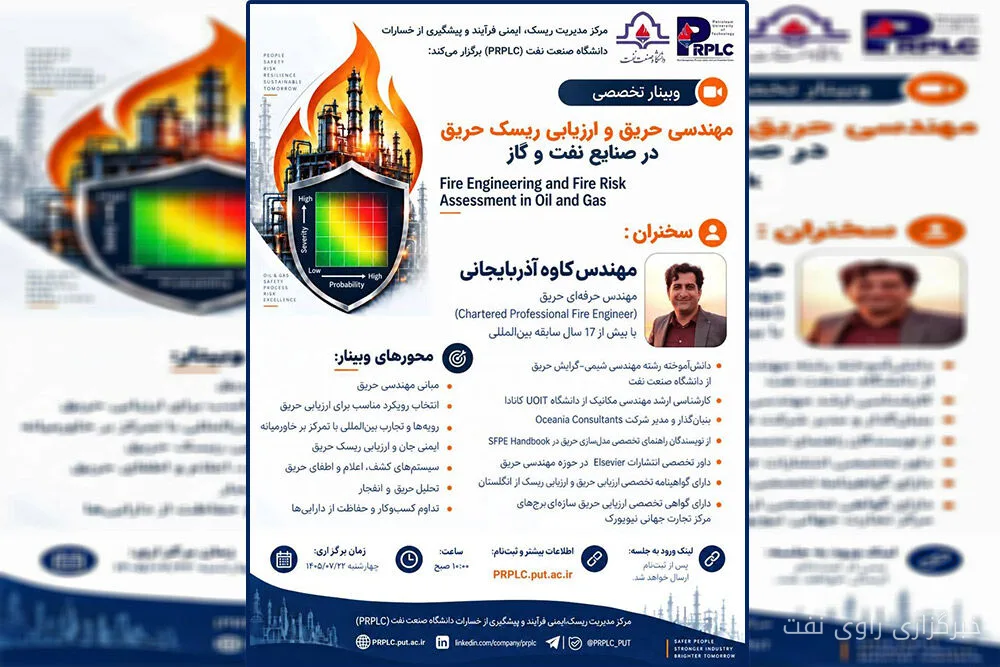
The specialized webinar "Fire Engineering and Fire Risk Assessment in the Oil and Gas Industries" aims to examine the fundamentals of fire engineering, risk assessment methods, and international experiences in safety and fire management in the oil and gas industries. It will be held virtually on Wednesday, October 14.
The Importance of Fire Engineering in the Oil and Gas Industries
Fire engineering is a specialized branch of safety engineering aimed at preventing fires, reducing the likelihood of explosions, protecting the lives of employees, and preventing damage to facilities and equipment in the oil and gas industries. Given the flammability of crude oil, natural gas, and many materials used in refineries and petrochemical complexes, the leakage of these materials near a spark or heat source can lead to widespread fires or explosions.
Read more: Hamid Bord's Meeting with Managers of the National Petrochemical Company
Webinar Topics and Related Discussions
The fundamentals of fire engineering, selecting the appropriate approach for fire assessment, international procedures and experiences with a focus on the Middle East, and fire risk assessment aimed at protecting lives are the main topics of this webinar. Additionally, fire detection, alarm, and extinguishing systems, fire and explosion analysis, business continuity, and asset protection will be discussed in this specialized session. In this context, standards and specialized guidelines, including those from the National Fire Protection Association (NFPA) and the American Petroleum Institute (API), are applied in the design of protective systems and risk assessments.
Fire engineering plays a crucial role in protecting employees and equipment by identifying fire and explosion hazards, designing detection, alarm, and extinguishing systems, and analyzing the potential consequences of incidents. In this field, engineers use modeling and specialized methods to examine thermal radiation intensity, flame spread, explosion pressure, and areas at risk.
Assessing the adequacy of the fire water supply network, fixed foam systems, cooling equipment, emergency exit routes, and the likelihood of incident escalation to adjacent units are also related topics in this area. Fire risk assessment helps identify potential incident scenarios and determine preventive and protective measures based on the severity of their consequences.
Those interested in attending this webinar can visit the address for more information and registration.
Read more: Emergency Management in Assaluyeh Petrochemicals · The Deputy of the Commodity Exchange Emphasized the Importance of Diversity in Production at Tabriz Petrochemicals