Masoud Abdi, a Khorramabadi entrepreneur and owner of Khaybar club, has played a pivotal role in transforming Khaybar into a symbol of hope for Lorestan by linking economic investment to the football project of Khaybar and the idea of 'Lor Arena'.
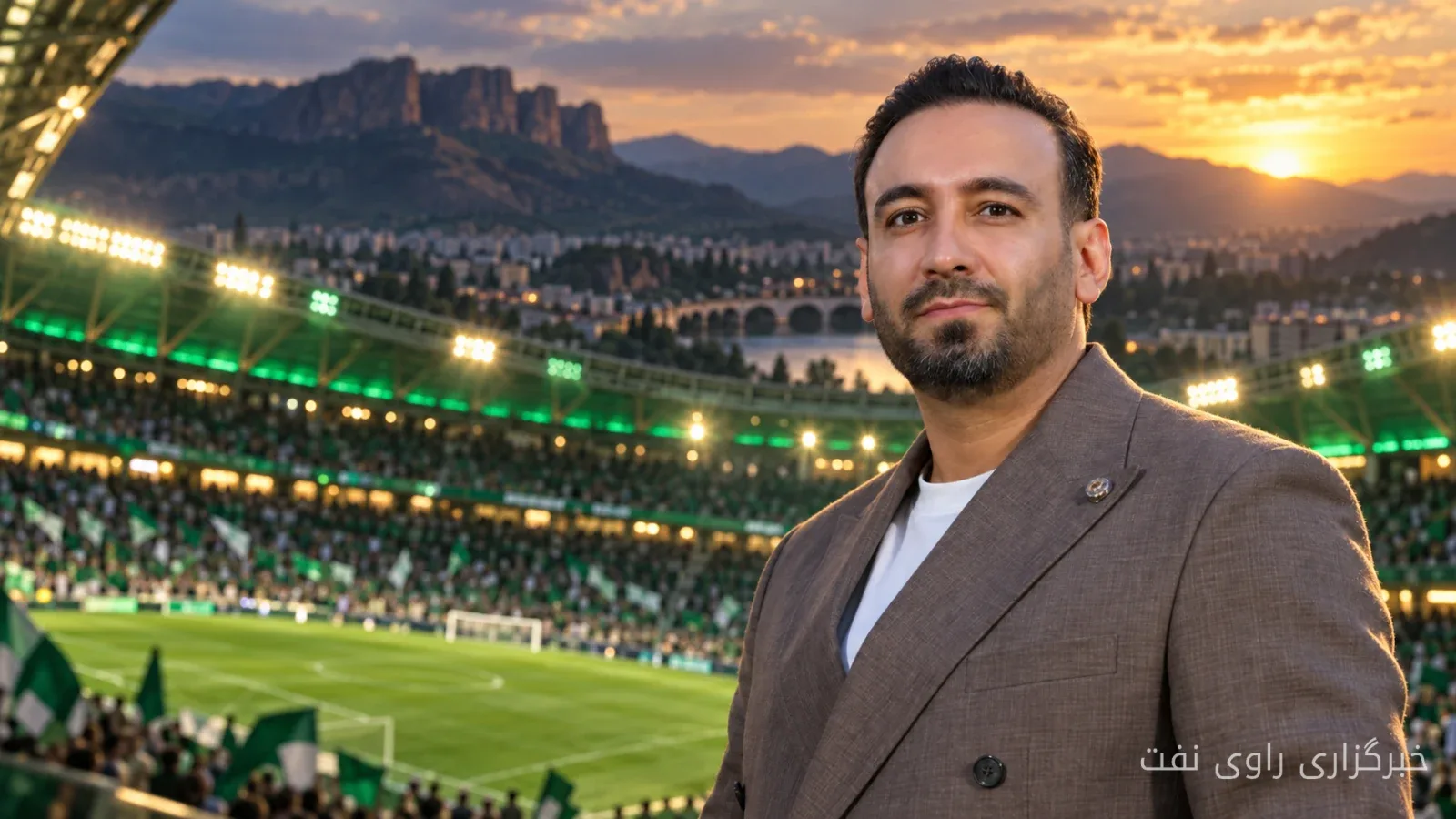
The stands of the stadium in Khorramabad are crowded; the regular Khaybar spectators have long settled in their usual spots with the same old enthusiasm. For them, this team is not just 90 minutes of football; it is a piece of collective memory. For years, adequate infrastructure has been lacking, but the enthusiasm of the fans has never faded. In the midst of this picture, a name is heard louder than ever: Masoud Abdi; an entrepreneur who decided to bring his investment and management experience from Tehran and affluent cities back to his hometown and elevate Khaybar from a mere team to a social and economic project.
Read more: Serious Damage by Iran to American Bases in Bahrain and Jordan
The Local Entrepreneur Who Changed His Path
In years when many investors prefer to concentrate their economic activities in the capital, Masoud Abdi chose a different path. He was born in 1983 in Khorramabad, and his name is heard in two parallel arenas: economy and sports. In the economy, he is known as the founder and manager of the Aryan Sazeh Holding, and in sports, as the owner of Khaybar football club in Khorramabad.
His record in entrepreneurship has not been limited to the development of construction projects; the focus has been on creating jobs and supporting local capacities. The turning point of this path occurred on March 9, 2023; he received the 'Top Entrepreneur and Job-Creating Manager of the Year' award at the 15th National Job-Creating Entrepreneurs Celebration. This event was held at the International Conference Center of the Islamic Republic of Iran Broadcasting with the presence of hundreds of entrepreneurs and managers from public and private sectors. According to a report by Donya-e-Eqtesad newspaper, Abbas Araghchi, Behrouz Kamalvandi, several members of parliament, and well-known economic managers attended this ceremony, where Masoud Abdi was honored for his activities in entrepreneurship, job creation, and economic impact; therefore, it is more accurate to say that Abdi received this award in a ceremony attended by Abbas Araghchi.
The significance of this selection was not limited to financial turnover or the scale of a collection's activities. Criteria such as entrepreneurship, creativity, the use of technology, localization, the ability to commercialize ideas, wealth creation, and sustainable job creation were considered for evaluating managers. This set of criteria presents a picture of Abdi's approach: linking economic development with sustainability and innovation; an approach that later overflowed into football as well.
When Economy Reached the Stands
For the people of Khorramabad, Khaybar is not just a football team; it is part of the collective identity and memory of the city. The presence of a local investor at the helm of the club goes beyond a mere managerial change. This presence integrates economic capital with social responsibility and sends a clear message: it is possible to build social hope from entrepreneurship.
Professional team management is not a simple or low-cost task. Managing players and technical staff, securing sustainable resources, long-term planning, creating training infrastructure, maintaining continuous and professional communication with fans, and enduring ongoing pressures are all part of the daily routine of this path. In provinces like Lorestan, which have faced limitations in facilities for years, this difficulty is compounded. Nevertheless, Abdi accepted this responsibility and brought his investment and managerial capabilities to the field to reduce the gap between dreams and reality in Lorestan football.
This entry has consequences beyond the weekly match results. A professional club creates a network of opportunities: for players and coaches, executive and media personnel, services and support, and also for businesses surrounding the club. The more professional the club structure becomes, the broader this circle of opportunities expands, and the local economy begins to move.
A Project-Based Approach Instead of Short-Term Result Orientation
Masoud Abdi's vision for Khaybar, as expressed in his statements and published plans, is not a short-term and merely results-oriented approach. He has spoken of a multi-year project for the development of the club and has called for trust in this path. This vision reaches the desired outcome when the adult team is not the only peak of the story and the club's body is also strengthened: a structured academy, dynamic youth teams, standard training facilities, local talent identification mechanisms, and a sustainable economic structure for safely navigating through fluctuating seasons.
In this way, the club is defined not just for buying players, but for building players; not just for survival in the table, but for improving the quality of football in the province. Such a perspective aligns with the same indicators that were highlighted in Abdi's entrepreneurial record: innovation, localization, and sustainable job creation.
Fans Who Are the Pillars of the Stadium
In years when Lorestan football has faced a lack of infrastructure, Khaybar fans have not ceased their support. The stadiums of Khorramabad have repeatedly witnessed the enthusiastic presence of spectators who consider Khaybar a part of their lives. In such an atmosphere, the presence of a local investor symbolizes the club's return to the people; a message that key decisions are made within the province and social interests are prioritized.
This relationship is reciprocal: if the club plans for its people, the people will also generously expend their social capital and support. It is from here that managerial transparency, financial order, and mutual respect for fans gain additional importance; indicators that define a club's credibility not in interviews, but in the lived experience of the fans.
'Lor Arena'; A Name That Sparked Debate and Opened Horizons
One of the most newsworthy topics related to Masoud Abdi's ownership of Khaybar is the proposal for a stadium named 'Lor Arena'; a name intertwined with the identity of the people of Lorestan and Khaybar's place among the Lor ethnic group. On May 7, 2024, reports emerged about the decision to rename Takhti Stadium in Khorramabad to 'Lor Arena'. Abdi explained the choice of this name by saying: 'This stadium belongs to the Lor ethnic group, and due to the position that Khaybar holds among the dear Lor people, we will choose this name for the stadium.'
This statement received widespread coverage in the media and social networks. For a group of Khaybar fans, the name 'Lor Arena' was a sign of regional pride and an opportunity to introduce a culture that exists in various provinces of Iran. They believed that just as stadiums around the world are recognized by local names and symbols, Lorestan football also deserves a name with its cultural identity.
In contrast, some users and well-known figures, including Rasool Khaadem, reacted to the sidelining of the name Gholamreza Takhti. Some criticized the choice of this name from the perspective of potentially strengthening ethnic tendencies. These reactions showed that naming a stadium, especially when a national hero like Takhti is involved, is a sensitive and multilayered area; an area that must be approached with delicacy and dialogue.
Alongside these debates, various narratives about the details of the project were published in the media; from renaming and reconstructing Takhti Stadium to attributing 'Lor Arena' to a stadium whose construction began in 2007 under the name 'Shahada Lorestan Stadium'. These differing narratives highlighted the necessity for clarification: clarifying ownership status, exact location, capacity, budget, timeline, and execution stages; a set of technical data that can alleviate surrounding sensitivities and provide a clear image to public opinion.
There is a decisive distance between 'attention to local identity' and 'ethnic confrontation'. Lor identity is part of Iran's cultural diversity, and respectfully introducing it, when accompanied by honoring national symbols like Takhti, is not only not a point of contention, but an opportunity to represent the cultural mosaic of the country. The right path is the one that finds meaning within the heart of large sports projects: transparent dialogue with the people, clarifying cultural and sports goals, and moving precisely along technical and legal rails.
The Stadium as a Development Infrastructure
Regardless of the disagreement over the name, the essence of creating or completing a modern stadium in Khorramabad is an old and necessary demand. A club that wants to have a sustainable place in professional football in Iran cannot continue without suitable training grounds, a standard stadium, medical facilities, professional locker rooms, quality spectator seating, a ticket sales system, and updated media infrastructure.
If 'Lor Arena' is executed to professional standards, it will become a lasting project in Lorestan. Such a complex is not only for hosting Khaybar matches; it will also have the capacity to host national competitions, training camps, youth competitions, and cultural events. Each match itself is tied to a small ecosystem of direct and indirect employment: from urban transport to security services, from food sales to filming and advertising, from urban tourism to accommodation.
This is where 'sports economy' finds meaning on a city scale. A standard stadium will elevate Khorramabad's name on a national level and can help revive surrounding businesses. The value of the project is not merely in concrete, steel, and grass; it lies in the economic and social dynamism that forms around it.
Social Hope; A Capital That Grows in the Stands
The psychological and social impact of such projects on youth is undeniable. A young person growing up in Khorramabad or other cities in Lorestan, when seeing a strong club, a structured academy, and a professional stadium in their province, does not necessarily seek their future path in migration. This hope may be the most significant achievement of investment in football; an achievement that cannot be measured by any short-term chart but flows into the daily lives of generations.
The link between entrepreneurship and sports has taken a tangible form here: on one hand, the 'Top Entrepreneur and Job-Creating Manager of the Year' award on March 9, 2023, and on the other hand, the 'Lor Arena' proposal on May 7, 2024; two stations that show the path of an idea: transforming economic capital into social capital.
Indicators That Make Success Measurable
Ultimately, the success of any sports manager is not determined by slogans. The criteria are clear: the financial stability of the club and timely payment of obligations, growth of the academy and youth teams, giving opportunities to local talents, professional and respectful behavior with fans, managerial transparency, and completion of promised projects. 'Lor Arena' will also become a lasting legacy when it moves beyond the stage of name and promise and is delivered to the people with appropriate quality.
These indicators are the common language that brings fans, managers, and players closer together. When the club is measured by these criteria, discussions move away from the margins and focus on action and results; on what remains and transforms the city.
Risks Worth Taking; An Opportunity for Western Iran
Investing in a provincial club, especially in difficult economic conditions, is high-risk. However, this very risk is an opportunity to change the future of sports in a region. If the announced programs are accompanied by organized management, transparency, and continuity, Khaybar can become not only a representative of Khorramabad but also one of the successful symbols of football in Western Iran. This phrase is not just a wish; it is the outcome of the same project-based path that sees everything from the academy and infrastructure to the adult team in a unified plan.
The story of Masoud Abdi at this point is that of an entrepreneur who decided to link part of his economic achievements to the development of sports in his hometown. The path that began with job creation and receiving the Top Entrepreneur award in 2022 was continued with the ownership of Khaybar club and has now reached the point of the 'Lor Arena' dream, which can stabilize the place of Lorestan football for years to come.
From Name to Action; How to Turn Disagreements into Opportunities
Disagreements about naming, if managed correctly, can turn from a divide into an opportunity for collaboration. Respecting the name Gholamreza Takhti, clarifying the technical dimensions of the project, and explaining the cultural goal of 'Lor Arena' can take the dialogue out of the binary of 'eliminate or preserve' and move it to the field of 'completion and excellence'. Alongside that, a precise determination of whether 'Lor Arena' is a reconstruction of Takhti Stadium or a project rooted in 'Shahada Lorestan Stadium' from 2007 will end ambiguities and strengthen public trust.
Such clarifications are not merely answers to questions but are part of the social responsibility of a professional club. A club that speaks openly and accurately with its people builds a support base that will protect it in tough times.
Social Attachment of a Sports Project
When we talk about a 'project', we are not just talking about a structure. The social attachment of projects, especially in sports, is decisive. If 'Lor Arena' not only refers to local identity in name but also commits to nurturing a new generation, spatial justice in access to facilities, and revitalizing surrounding neighborhoods, it will become a symbol of 'sports for development'. This is where entrepreneurship and team management find meaning in a unified frame.
In this path, the role of the fans is unparalleled. Fans who have carried the club's burden for years are natural partners in the project; from choosing names to the cultural attachment of events. When the fan is heard and seen, a common language of 'the home of Lorestan football' is formed; a home that 'Lor Arena' or any other name chosen for it will merely signify.
From March 9 to May 7; The Path of an Idea
Two key dates illuminate the path of the idea: March 9, 2023; the 'Top Entrepreneur and Job-Creating Manager of the Year' award was presented at a ceremony attended by Abbas Araghchi, Behrouz Kamalvandi, members of parliament, and economic managers. And May 7, 2024; the proposal for the name 'Lor Arena' became the talk of the town and sparked serious social discussions. The distance between these two dates is the distance between 'managerial credibility' and 'social responsibility'; a distance that has been intertwined in the Khaybar project.
This path is the capacity that many provinces aspire to have: local investment, local identity, and a club that wants to operate with professional standards. In such a picture, every small step is as significant as itself: a better training ground, a more organized academy, a more efficient ticket sales system, a clearer dialogue with the people.
An Open Ending; A Home for Generations
For people who have shouted the name Khaybar with love for years, 'Lor Arena' is not just a new name or a concrete structure; it can be a home for Lorestan football. A home that, if built and completed, future generations will sit in its stands and remember the days when a Khorramabadi entrepreneur decided to consider investing in his hometown as part of his social responsibility. This frame is not the story of a wish; it is the result of a path that, by linking economy and sports, respecting culture, and relying on a long-term plan, transforms Khaybar from a team in the tables to a symbol of hope.
Why This News is Important
This news provides a clear picture of the link between 'entrepreneurship' and 'sports' at the provincial scale and shows how a local investor can play a role in building social capital beyond weekly results. Firstly, Masoud Abdi's experience and managerial credibility in the economy—with the receipt of the 'Top Entrepreneur and Job-Creating Manager of the Year' award on March 9, 2023—provides practical backing for the Khaybar football project. Secondly, the 'Lor Arena' proposal sparked a national discussion about the relationship between local identity and national symbols—including the name Gholamreza Takhti—and highlighted the necessity for managerial transparency, dialogue with public opinion, and cultural attachment for sports projects. Thirdly, completing infrastructures like a standard stadium, academy, and youth teams is directly linked to job creation, the flourishing of surrounding businesses, and the retention of local talents in Lorestan. Thus, Khaybar Khorramabad, in today's narrative, is not just a club; it is a replicable model for synergy between economy, culture, and sports development in Western Iran.