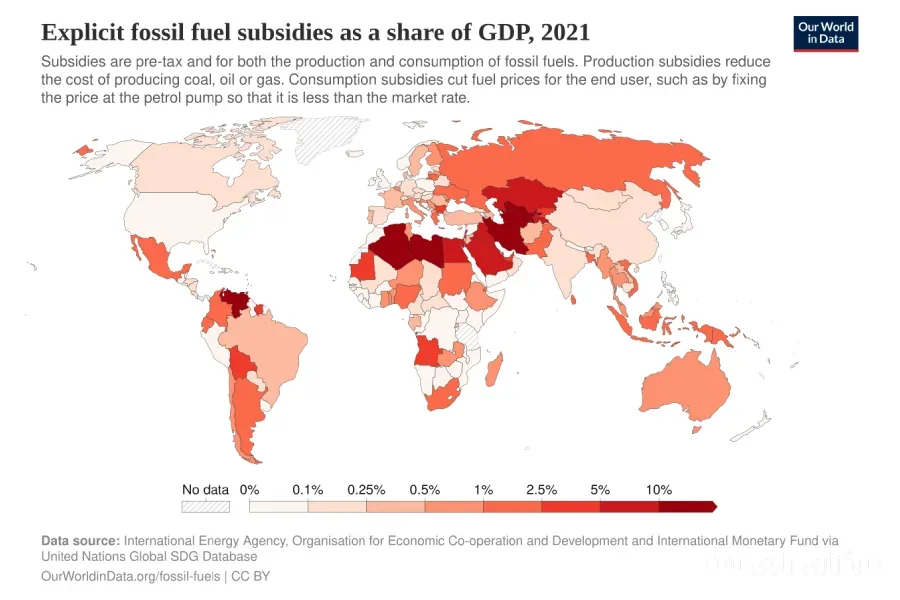
Iran ranks first among countries with the highest fuel subsidies with a figure of $35.81 billion. This ranking was published in April 2026 by SeaStats and refers to data from the International Energy Agency (IEA).
Method of calculating fuel subsidies
This number does not mean that the Iranian government has directly paid this amount from its cash budget. The IEA calculates the fuel consumption subsidy using the "price gap" method, which measures the difference between the reference energy price and the price paid by consumers. For exporting countries like Iran, a significant part of this figure can represent the opportunity cost of selling domestic fuel at lower prices than the reference prices.
Read more: Constraints of the Canadian natural gas market under structural changes
According to the published table, after Iran, Indonesia ranks second with $12.67 billion and Saudi Arabia ranks third with $12.26 billion. Iran's fuel subsidy figure is nearly 2.8 times that of Indonesia. This is one of the notable points of this statistic that should be taken into account.
Legal and economic dimensions of fuel subsidies
The IEA compares the price paid by consumers for fuel with the reference price to calculate the fuel consumption subsidy. In oil-exporting countries where domestic fuel is offered at lower prices, this gap can be recorded as an opportunity cost. Therefore, the estimated figure should not be equated with "the budget credit paid to the people."
Legally, the National Iranian Oil Company is one of the main subsidiaries of the Ministry of Oil and has an independent legal personality. The current charter of this company also identifies it as a company established based on the law of nationalization of the oil industry. Therefore, in public discourse, Iran's oil and gas resources can be referred to as national wealth; however, legally, it is more accurate to say that the National Iranian Oil Company is a state-owned company and subordinate to the Ministry of Oil.
The issue of fuel subsidies in Iran cannot be examined separately from the consumption pattern. Part of the pressure on energy resources is related to factors such as high consumption of old vehicles, low vehicle efficiency, fuel smuggling, and poor consumption management.
Challenges and solutions for reforming fuel subsidies
The IEA warns that extensive and non-targeted subsidies can distort prices and lead to increased consumption and financial pressure. At the same time, the IEA emphasizes that governments face a significant issue in keeping energy affordable for consumers, and energy support still exists in many countries.
The issue of fuel subsidies cannot be limited to merely "removing or maintaining subsidies." A policy framework worth considering is to support household purchasing power and reduce waste, smuggling, and inefficient consumption simultaneously. In such an approach, instead of directly transferring the pressure from energy price reform to households, focus can be placed on reducing the consumption of old vehicles, optimizing the fleet, controlling smuggling, and making support more targeted.
Ultimately, what combination of these policies is implemented is an economic and policy decision that requires simultaneous consideration of its effects on inflation, government budget, fuel consumption, household welfare, and investment in the energy sector. The figure of $35.81 billion represents the magnitude of the estimated price gap in Iran's fuel consumption, not necessarily a cash payment equivalent to this amount from the government budget.
Read more: New Dallas Fed survey of the energy sector indicates instability in the market · The Chinese government will defend the rights of companies purchasing Iranian oil