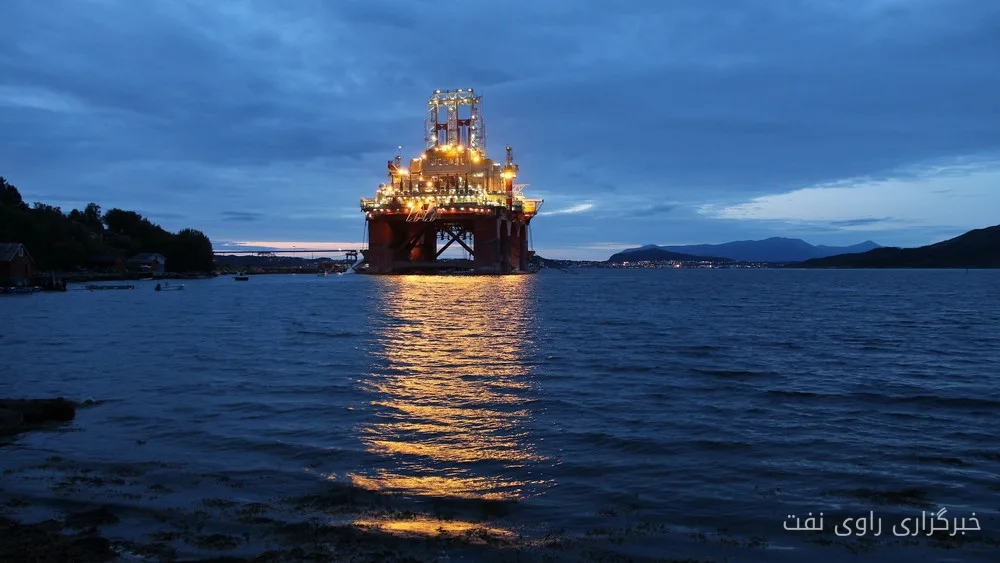
Norway's oil and gas industry, which has relied on major discoveries for over half a century, is now on the brink of a significant production decline. The last major discovery in the country was the Wisting field in the Barents Sea, made over a decade ago. Since then, explorations along Norway's coast have focused on smaller discoveries close to existing infrastructure.
Production Decline and Exploratory Challenges
This approach, while helping to maintain production in the short term, cannot prevent the projected decline in production by 2040. According to Rystad Energy forecasts, Norway's production will face a shortfall of 1.9 million barrels of oil equivalent per day (boepd) by 2040. This shortfall represents significant challenges facing the upstream oil and gas sector in the country.
Read more: Ministry of Oil and Management Challenges in Iran's Oil Industry
If exploratory activities remain at the same level as the past decade, this shortfall is expected to reach 2.2 million boepd. Even if the time required to exploit discoveries is reduced, this figure will decrease to 2.1 million boepd. Similarly, doubling the volume of explorations, despite the reduced development time, will not be able to address this shortfall, leaving a production gap of 1.4 million boepd.
Need for a Change in Exploratory Strategy
Norway's challenge is not due to a lack of resources or exploration economics, but rather its diminishing ability to make large discoveries. From 1969 to 2010, every offshore discovery over one billion barrels of oil equivalent (boe) was made, and since 2016, explorations have yielded only about 3.2 billion boe, averaging 320 million boe per year. At this rate, it will take over 30 years to discover the remaining 11 billion boe.
Despite Norway having 31.7 billion boe of remaining offshore resources and a 60 percent exploration success rate, which is above the global average of 55.5 percent, the main issue is the size of discoveries. Each successful well adds an average of 7 million boe to reserves, while this figure globally is 18.4 million boe. Given exploration costs that are nearly in line with the global average and Norway's oil tax system covering a significant portion of exploration costs, the problem relates to the size of discoveries.
Recent changes in Norway's exploration strategy reflect hope for a return to larger discoveries. Three major companies along Norway's coast have agreed to jointly drill about five high-impact wells over the next five years. Additionally, the government has offered 70 new blocks in this year's licensing round. These licenses are likely to be granted early next year, providing an opportunity to reassess exploratory priorities and Norway's long-term resource potentials.
However, success in converting these developments into a sustainable improvement in exploration depends on operators' willingness to invest in higher-risk projects and access to new lands. Furthermore, new policies regarding drilling in the Arctic may aid exploration in this region, which is increasingly important for Norway's future production.
Read more: Analysis of the Status of Access to Marine Fuels in North America · Fluor and Inlectra Sign Cooperation Agreement in Venezuela's Energy Sector