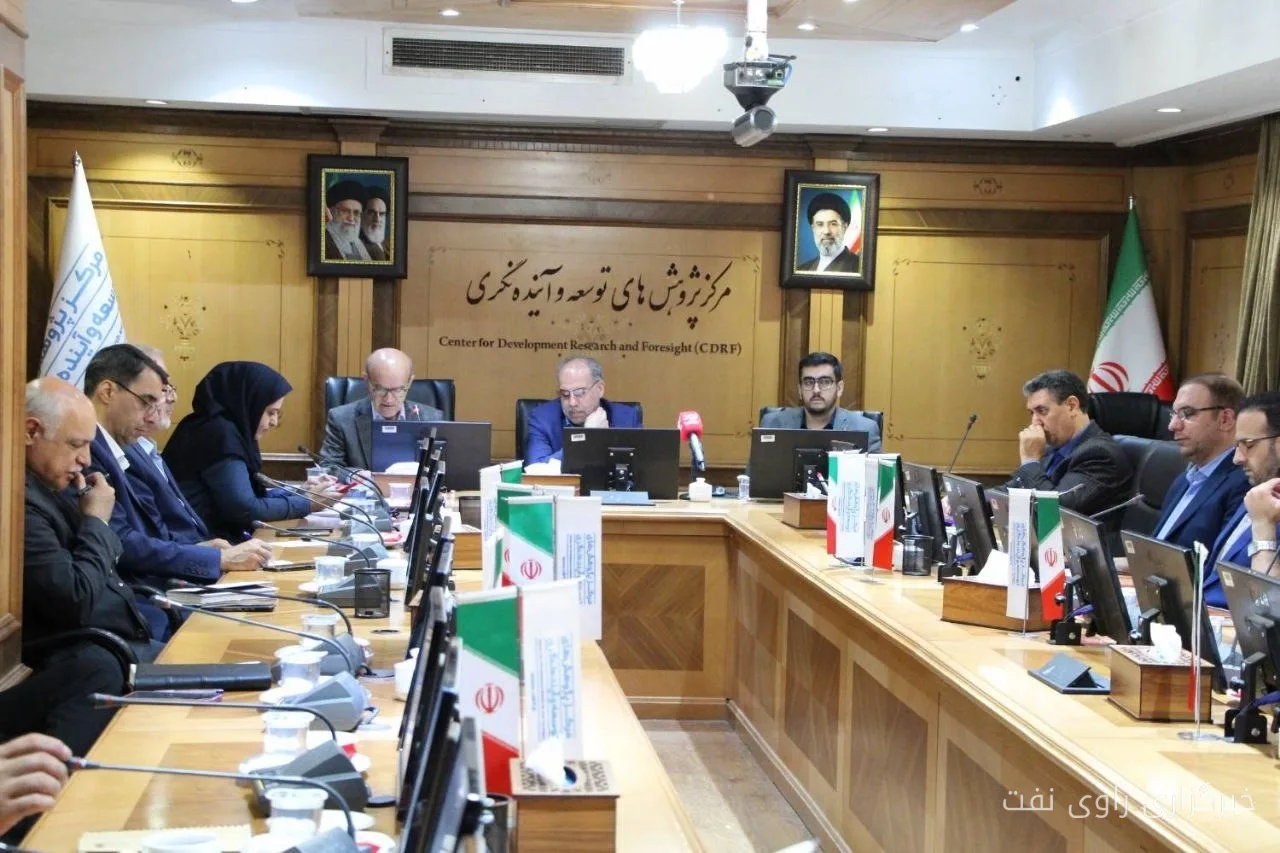
Industrial development in Iran's economy has been intertwined for decades with a wave of written documents, archived strategies, and constant changes in executive leadership. An examination of the country's industrial record shows that despite a multitude of quantitative goals, a significant portion of the country's production still relies on the benefits of cheap energy and resource-based industries. In this context, the 255th scientific-specialized meeting of the Development Research Center and Foresight, titled "Exploring and Analyzing the Challenges of Industrial Development in Iran with Emphasis on Policy Evaluation," hosted Morteza Khalasi, Seyyed Mohammad Bahrinain, and Reza Mousavi to provide a detailed dissection of the roots of the failures of industrial policies in Iran.
The Trap of "All Priorities" and Neglecting Energy Imbalance
Morteza Khalasi, Head of Industry, Mining, Trade, and Communications at the Organization for Planning and Budget, described the current production conditions and the simultaneous pressures of energy, water, liquidity, and inflation constraints, reminding that since the early 2000s, numerous documents have been drafted, and almost with every managerial shift in the Ministry of Industry, Mine, and Trade, a new framework has been unveiled; however, the performance of the last 15 years shows a significant gap from the goals.
Read more: The dry cargo market experienced a slight recovery in week 38 of 2026
Khalasi pointed to the issue-based approach of the seventh development plan focusing on chains such as steel, copper, and petrochemicals, warning that part of the country's industrialization was solely based on cheap energy and feedstock rents, leading to the development of capacities that were neither connected to completing the value chain nor produced final products with high added value.
Bahrinain: Development is Not the Top Priority of Governance
In another part of the meeting, Seyyed Mohammad Bahrinain, a development researcher and industry activist, identified the main root of failure as the lack of a "unified political will" and the fragmentation of decision-making, stating: The experience of East Asia is before us; financial resources and experts alone do not bring about development unless industrialization becomes the top and inviolable priority of the country at the highest governance levels.
Bahrinain strongly criticized the multiplicity of decision-making bodies and parallel councils, emphasizing that when several institutions have overlapping authorities, accountability becomes diluted, and no one is responsible for the failure of a policy. On the other hand, neglecting the criterion of "professional competence" has led to managers in charge of complex sectors such as industry, energy, and oil who lack a deep understanding of production logic and value chains.
He suggested that a structure composed of experienced entrepreneurs, experts, and scientific elites take on the responsibility of long-term policy-making, while the Organization for Planning and Budget should play the role of a specialized secretariat and data analysis and modeling institution.
7 Major Barriers to Industrial Policy; Which Agency Commands Development?
Reza Mousavi, a policy researcher in development economics and Secretary of the Strategic Studies Office for Production Boom, reminded of the powerful return of industrial policy to the major economies of the world amid geopolitical competitions, adding: "For a country under sanctions and external shocks, industrial policy is not just a growth driver but a shield for production resilience.
Mousavi summarized the structural challenges of Iran's industrial policy into 7 key areas: lack of dynamism in keeping up with emerging technologies, financing challenges and decline in capital formation, weak R&D and severed ties with global technological networks, and market barriers, export isolation, and non-economic production scales.
In summarizing the discussions of this specialized meeting, it was emphasized that the salvation of the country's industry does not lie in writing a new document alongside dozens of previous documents. Escaping the low growth trap requires an immediate transition from "false advantage based on cheap gas and electricity" to "linking knowledge and production, competitive scale, transparency in directing credits, and establishing a powerful guiding institution"; an institution capable of resisting short-term decisions and freeing industrial development from day-to-day routines.
Read more: U.S. and Ansarullah Talks Following Saudi Oil Crisis · Trump's Controversial Prediction: Gas Prices Will Drop After the Elections