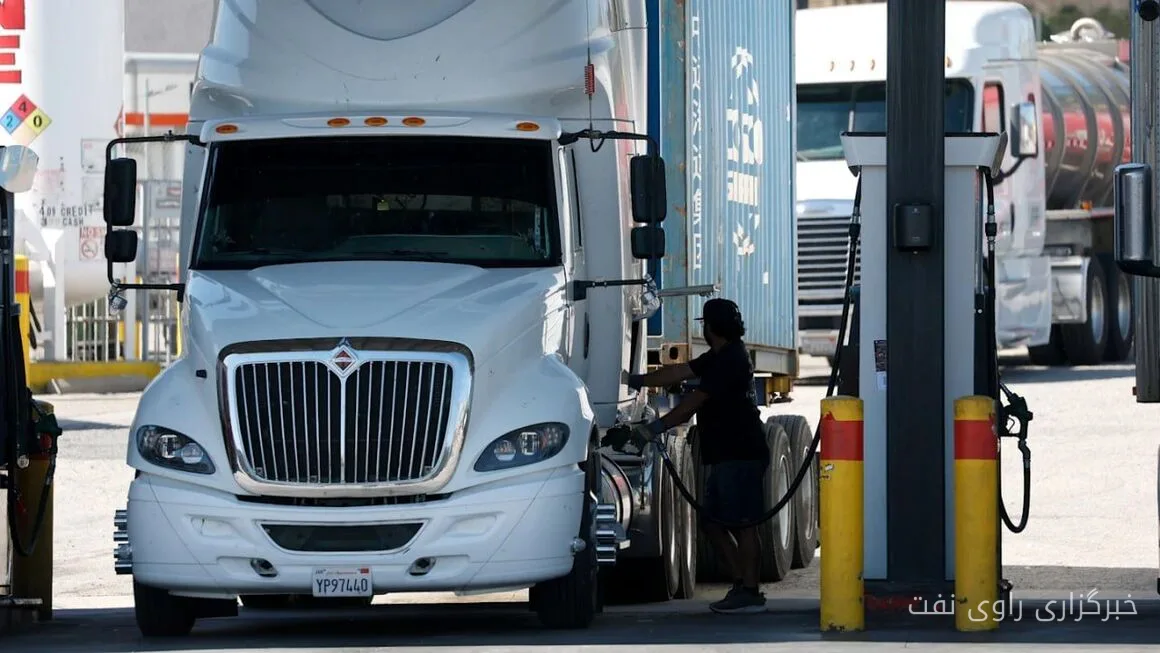
America has decided to ban the export of this petroleum product in order to control the unprecedented rise in diesel prices in the country and Europe. Donald Trump, the President of the United States, has expressed his support for this action, and some Republican candidates in the upcoming elections have called for the implementation of this ban to curb fuel prices.
Reasons for the Increase in Diesel Prices
Ongoing wars, especially in Ukraine, and tensions between America and the Israeli regime with Iran have led to a decrease in exports from major global producers such as Russia, Saudi Arabia, and the United Arab Emirates. These factors have driven diesel prices to their highest level, putting significant pressure on American families and the energy market.
Read more: Public Consultation Meeting on Natural Gas with Ahmad Zera'atkar
The rise in fuel prices has been highlighted as a vulnerability for Trump ahead of the November 3 elections. In this context, Scott Basset, the U.S. Treasury Secretary, has announced that the government is reviewing the details of the diesel export ban and its effectiveness.
Support and Opposition in Congress
Several Republican senators, including Dan Sullivan, Senator from Alaska, and Ashley Hinson, Representative from Iowa, have urged the Trump administration to implement the diesel export ban. Sullivan emphasized in a statement that fuel produced in America should be for domestic use and called for a temporary halt to diesel exports to rebuild storage tanks before the winter season.
At the same time, energy officials, including Chris Wright, the U.S. Secretary of Energy, have warned against this action, stressing that the export ban could lead to a surplus of diesel on the Gulf Coast and reduce gasoline production. He noted, "If you create a barrier in the supply chain, production will quickly decline, and you will face a supply shortage. We need more supply, not less."
Economic and Social Consequences
Doug Burgum, the U.S. Secretary of the Interior, also pointed out the consequences of this ban, stating that it is unlikely to reduce petroleum product prices and may lead to retaliation from energy-exporting countries. Todd Staples, President of the Texas Oil and Natural Gas Association, also believes that this ban will harm domestic businesses and cause fuel shortages.
Although this ban could temporarily reduce prices on the Gulf Coast, it will severely limit supply to Europe. Jim Mitchell, head of oil trading analysis at the consulting firm Wood Mackenzie, has assessed this action as detrimental to some of America's key allies.
Read more: Italy Emphasizes Increasing Fuel Production Amid Rising Prices · Return of Soybean Exports to China from the United States to 9.858 Million Tons



