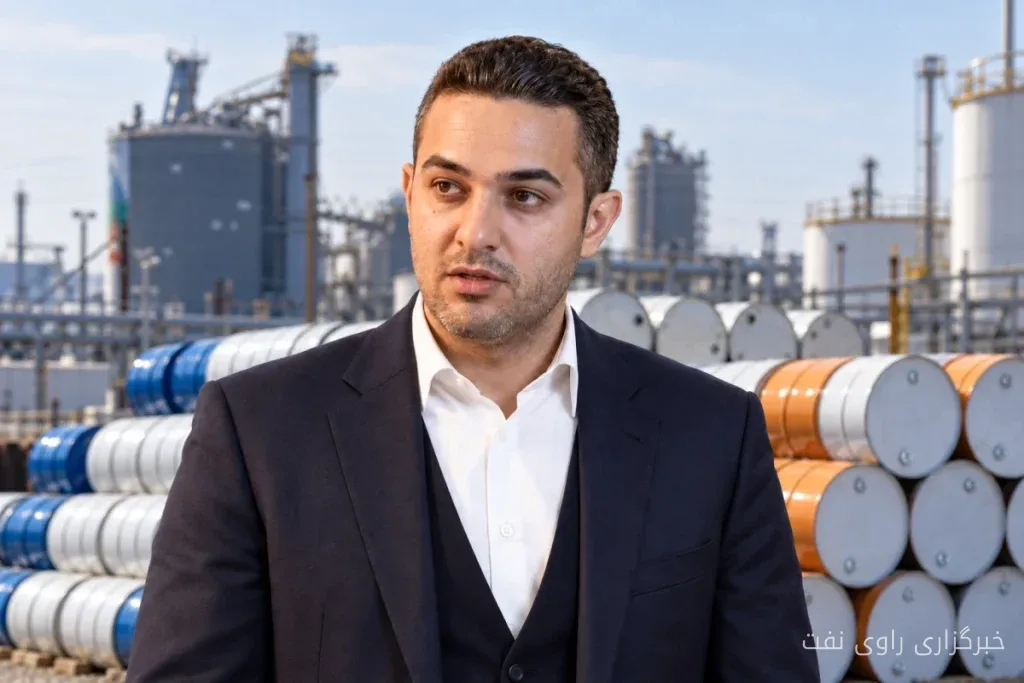
According to media reports and documents from this case, Mohammad-Hadi Momenin, born in 1989 and a debtor of 743 billion tomans to the banking system, accessed shipments of 72 to 80 million barrels with discounts of 8 to 17 dollars per barrel from the heart of the oil trust network, and his name has been recorded among the biggest currency ambiguities of recent years.
This one sentence is enough to clarify the weight of the matter: a young figure whose name first appeared on the 'list of major bank debtors' suddenly found a place at the core of Iran's oil transactions; a place where credit allocations, unprecedented discounts, and currency return channels determine the fate of national resources. Mohammad-Hadi Momenin stands alongside three prominent trustees—Ali Bayandarian, Rouhollah Razavi, and Hossein Shamakani—in the center of a case that has questioned everything from the allocation of shipments to the mechanisms of eligibility assessment; and in this quadrilateral, his role is highlighted due to the volume of figures, the extent of exchange office and domestic and foreign company ownership, and the trace of unreturned currencies.
Read more: Widespread Violations in Marward Petrochemical with a Million Dollar Overpricing
The 1989 Youngster on the Oil Artery: From the Debtors List to the Trustee Circle
Mohammad-Hadi Momenin's path began with exchange offices and foreign trade; however, the turning point was his entry into a system that placed oil credit sales on the shoulders of 'eligible intermediaries' and positioned his name alongside three powerful figures in this field. A recent and controversial report from Hamshahri Online identified these four as the center of discussion: Bayandarian, Razavi, Shamakani, and Momenin. In front of public opinion, four immediate questions arose: How and based on what 'eligibility' were these shipments allocated? What amount of discount was given and from what source? How and when were settlements made with the Ministry of Oil? And why did knots arise in the currency return chain that have yet to be untangled?
In this framework, Momenin is introduced not as a simple broker, but as an executing link in a multi-layered network: a network that extends from domestic banking to international exchange offices and even includes commercial hideouts in Venezuela. It is precisely this geographical breadth and financial tool diversity that makes his place in the trustee puzzle special.
Allocations from Khordad to Mordad 1405: 72 to 80 Million Barrels, 8% Discount
According to reports published in the media, including Hamshahri and Kayhan, from Khordad to Mordad 1405, approximately 72 to 80 million barrels of crude oil were allocated to the four main trustees—Bayandarian, Razavi, Shamakani, and Momenin. The nature of the allocation was 'credit'; that is, the oil was to be delivered, and the money was to be returned. However, this 'must' was tied to a significant privilege: heavy discounts. A discount of about 8%, equivalent to 8 to 17 dollars per barrel. The result is clear: an amount between 576 to 680 million dollars of 'net discount' flowed from public resources into the accounts of the four intermediaries.
Alongside this heavy figure, some experts and representatives, considering the sale of these shipments in secondary markets, have estimated the gross profit and the difference from brokerage to be up to 1.5 billion dollars. In this playing field, Mohammad-Hadi Momenin took a special position; both due to his share of the shipments and the financial network that surrounded his transactions. Here, we were no longer dealing with 'normal commercial discounts'; we were dealing with 'penetration coefficients'.
From the Major Debtors List to the Company Puzzle: How Did Momenin Rise?
Mohammad-Hadi Momenin, born in 1989, first came to the news through the major bank debtors list. In the latest reports of overdue debts, he was introduced with a debt of 743 billion tomans to Kaarafarin Bank. According to 'Oil Desk', Momenin also had significant debts to Saman Bank and simultaneously held specific shares in major transportation and aviation companies such as 'Mahan'. This is not his only 'banking record'; his corporate record is also extensive.
A look at company registrations shows that Momenin has been present in the board or management of over 40 domestic companies. Clear examples include: board member of 'Pars Taban Sarv', vice-chairman of the board of 'Petro Sam Eurasia', and board member of 'Tamin Tose'e Adrien'. Simultaneously, he also had 'Mohammad-Hadi Momenin and Partners Exchange Office' as his main currency arm. Putting these pieces together creates a clear picture: a large legal body to manage money and contracts, and an exchange office for the final settlement of currencies.
Foreign Arm: From London to Madrid; Companies for Money Circulation
The dimensions of this young trustee's economic activities extended beyond Iran's borders. Legal and commercial investigations show that Momenin created a transnational network to cover his financial activities: in the UK by registering and managing companies like 'Momenin Investment Group' and 'Cellpack Ltd' and in Spain by collaborating with international trading companies. This foreign arrangement provided the 'capacity for ownership circulation' and 'currency transfer' necessary for oil transactions; the very thing that, in the trustee mechanism, acts as the oxygen of the transaction, without which the system shuts down.
The practical meaning is simple: oil, on paper, reaches the buyer from the broker, its money must return, but the movement of money must pass through channels that both circumvent sanctions and are tidied up in official balances. When the broker has dozens of companies inside and several companies outside and the exchange arm is also himself, the question precisely arises from here: where are the traces of the money, and who sees it?
Tracing Unreturned Currencies and Venezuela: Figures of 2 Billion and 1 Billion on the Table
The heaviest part of this case lies here: the non-return of revenues from oil sales. In recent weeks, some Persian-language media outlets abroad reported that Momenin received about 2 billion dollars from the financial resources obtained from the sale of Iranian oil during the receipt of oil shipments but did not return it to the country's economic cycle. This figure, wherever it stands, has a direct message: in the currency return chain, a knot named 'Momenin' has been placed that has taken all figures out of orbit.
The name Momenin, in addition to domestic cases, is also seen in one of Iran's most important international fields: Venezuela. Iran's large export project to Venezuela was suddenly halted after the arrest of that country's oil minister on charges of widespread financial corruption, and the fate of about one billion dollars of Iran's currency claims became shrouded in ambiguity. Reports have recorded Momenin's involvement in this transnational case, and part of the financial ambiguities regarding the non-return of resources is tied to his performance and corporate network. According to these reports, after increasing regulatory and judicial pressures, Momenin's residence shifted from the UAE to Oman and then to China, and from there, he suspended settlements with creditors and official entities.
These lines, together, create a unified image: a foreign network for receiving and transferring money, a diverse legal body to cover contracts, and an exchange loop for concealing paths; and in the end, an ambiguity as large as billions of dollars.
Supporters and the 'Shayan' Circle: Who Gave Permission, Who Protected?
Easy and unregulated access of a young figure to multi-billion dollar shipments without relying on informational, structural, and supportive rents is impossible. In analytical reports, the names of some influential figures in the decision-making structure of the Ministry of Oil have been recorded as supporters and facilitators of Momenin's activities; including 'Mohammad Bahmaei', who is recognized as one of the influential individuals in the financial decisions of the Ministry of Oil and the allocation of resources to trustees, and in some reports, he has been named as Momenin's main supporter.
Momenin's network, apart from these backers, was also linked to other currency and oil intermediaries: Rouhollah Razavi, Ehsan Tahiri, and Mohammad-Javad Baavand. Based on revelations, these individuals formed an intertwined circle that, under the management and cover of individuals with security and structural backgrounds—including a person with the alias 'Shayan' (former director general of fuel and energy)—received oil shipments, sold them on the black market, and ultimately refused to return the currency resources. Momenin was one of the main actors in execution and exchange in this network, relying on the capabilities of his multiple companies to launder and transfer funds.
This tracing has an immediate result: accountability must go beyond the level of a broker and reach decision-making levels; where signatures were placed on 'credit transfers', where '8% discounts' became the norm, and where 'eligibility assessments' were blurred or eliminated with a gesture.
The Laid-Out Trustee Table: Huge Discounts, Lost Guarantees
Exemptions and exorbitant discounts to intermediaries are the main sensitivity of public opinion in this case. A discount, if a tool for facilitating sales, should be accompanied by strict guarantees for the return of currency; however, what happened was credit allocations with unprecedented discounts and guarantees that we are now looking for and do not receive clear answers. When 576 to 680 million dollars of 'net discount' goes into the pockets of four intermediaries, the obvious question is: who signed this 'price deduction' from public resources, and where was the guarantee for collecting the 'full price' placed?
Now the names are clear, the figures are on the table, and the paths are somewhat known: Bayandarian, Razavi, Shamakani, and Momenin; 72 to 80 million barrels in three months; 8 to 17 dollars discount per barrel. In this context, Momenin's share and role, considering his exchange office and companies, was the connecting point for allocation and currency transfer. If today 'non-return' is being discussed, the point of examination is precisely this connection.
Clear and Unanswered Questions of Public Opinion
The case of Mohammad-Hadi Momenin does not end with one person; it is a mirror of a mechanism that circumvents the oversight structure under the name of 'circumventing sanctions'. The questions are clear and demand answers:
First—What is the exact figure of Momenin's debts and unreturned currency to the National Iranian Oil Company and banks, and how much of it is 'collectible'? When and where will the official statement, with details shipment by shipment, be published?
Second—Which entities and managers at the time approved the commercial, financial, and security eligibility of a figure with large banking debts to receive billion-dollar oil shipments? The list of signatures, dates, and permits must be presented without omission or hesitation.
Third—What credible guarantees were obtained for the return of this volume of national capital from intermediaries? Where are these guarantees today, and why have we reached a point of 'disappearance' or 'non-return' of billions of dollars in execution?
When there are no answers, the result is clear: the path of rent remains open under the name of 'facilitating exports', and the damage is recorded in public offices.
Face to Face with Figures: How Did Momenin Become the Main Knot?
To understand Momenin's role, it is enough to trace the path from the end to the beginning: currency does not return; why? Because the transfer loop is private and hidden. Why is the loop private and hidden? Because interconnected companies and exchange offices erase the trace. Why did these companies enter the game? Because allocations were made without strict eligibility assessments. And why was there no strict eligibility assessment? Because supporters and facilitators in the official structure left the gates open. The names are clear; the roles are defined.
In this network, Momenin has both a legal signature (boards and exchange offices), practical access (foreign channels in the UK and Spain), and a 'banking file' that should alone sound the alarm. Strangely, this 'banking file' not only did not cut him off from oil resources but also handed him the key to the warehouse.
Tehran, UAE, Oman, China: The Line of Movement and Stopping of Settlements
According to media reports, after the intensification of regulatory and judicial pressures, Momenin moved from his residence in the UAE to Oman and then to China, and from there, he suspended settlements with creditors and official entities. This movement line precisely signifies the same 'multi-layering' that makes collection difficult and pursuit time-consuming. When a broker, through corporate and exchange networks, erases borders for money and the broker himself, the collection of national resources becomes a deadlock.
The Lesson from Venezuela: The Halt of a Project, the Ambiguity of One Billion Dollars
The Venezuela case alone is sufficient to assess the risk of a 'trustee-oriented' approach. The large export project was suddenly halted after the arrest of the then oil minister of Venezuela on charges of financial corruption, leaving about one billion dollars of Iran's claims in limbo. Momenin's presence in this case and the connection of part of the financial ambiguities with his network show that 'broker eligibility assessment', 'contractual coverage in a third country', and 'the path of ensuring currency return' are three rings that either did not exist at all or were ineffective. The result was what we see today: large figures and small answers.
Clear Demand: From Names to Signatures, Everything on the Table
This case has no endpoint except through complete transparency: the list of shipments, dates of allocation, percentage and amount of discount, final buyer (as legally possible), settlement deadlines, guarantees obtained, destination of currency, and date of arrival. Additionally, the minutes of eligibility assessments, the names of committee members, and the role of individuals like Mohammad Bahmaei in allocating resources to trustees must be published without omission or courtesy. In the execution circle, the roles of Razavi, Tahiri, and Baavand as cooperating intermediaries, and the position of 'Shayan' as managerial cover with security background, must be clearly and officially explained.
Mohammad-Hadi Momenin, with his banking, corporate, and currency record, is no longer just a 'case'; he is a 'sign'. A sign that when 'intermediaries' replace 'transparent structures', oil—meaning the sweat and future of the people—is sold at discounts of hundreds of millions of dollars, and the return of its money gets lost in the whirlpool of hidden circles.
Why This News is Important
This case targets the heart of the budget and livelihood. When 72 to 80 million barrels of oil are allocated with discounts of 8 to 17 dollars per barrel and 576 to 680 million dollars of 'net discount' reaches four intermediaries, the discussion is not merely a commercial contract; it is about the 'national wallet'. Mohammad-Hadi Momenin's name is at the center of this affair, with a debt of 743 billion tomans to the bank and a network of domestic and foreign exchange offices and companies, equivalent to a 'systemic warning': a mechanism that has bypassed eligibility assessments, unsecured credit allocations, and has not entrusted the return of currency to the normal process of 'settlement'. When the trace of two billion dollars of unreturned currency and the ambiguity of one billion dollars in Venezuela are on the table, the public demand is simple and urgent: fully, publicly, and accountably disclose the names and signatures; announce the guarantees and paths for the return of currency; and reform the structure that entrusts oil to the trust so that tomorrow, another name does not emerge from the shadows and repeat the same path.
Read more: The Security Manager of Marward Petrochemical in Tehran is Hiring