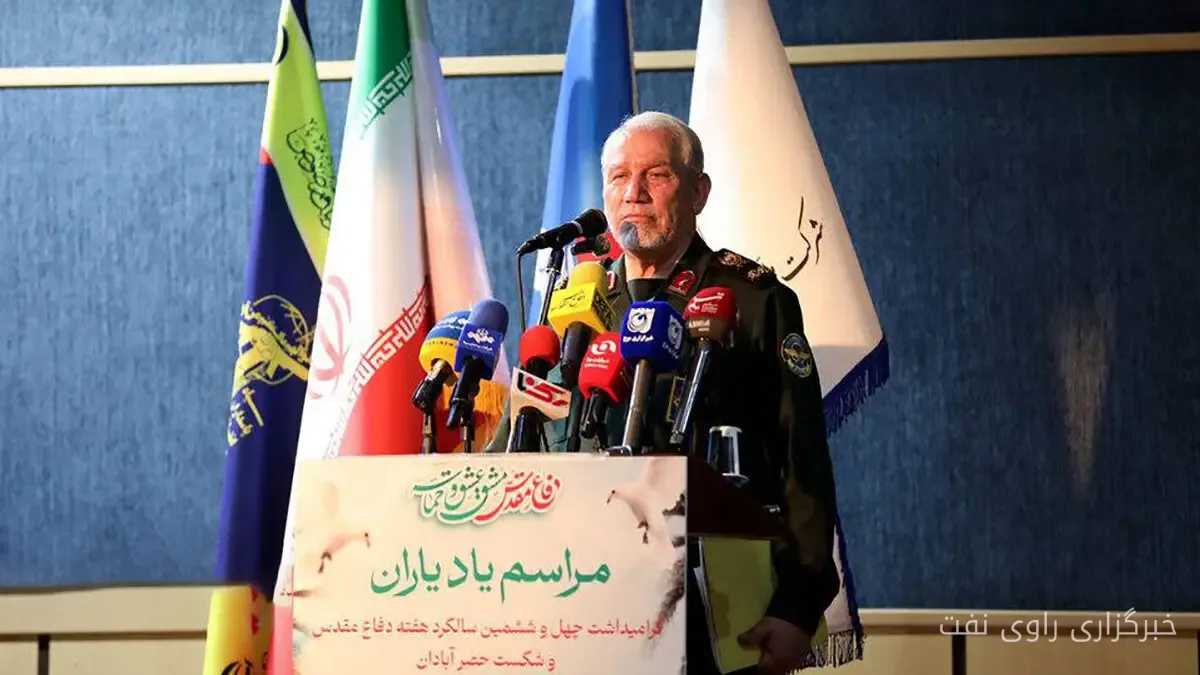
Seyyed Yahya Rahim Safavi, assistant and senior advisor to the Commander-in-Chief, conveyed the greetings of the Supreme Leader to the attendees during a meeting with employees, engineers, and managers of the oil industry, expressing gratitude for their efforts and emphasizing the vital role of Iran's oil industry at various historical junctures.
The Geopolitical Impact of Energy on Iran
Rahim Safavi addressed the topic of "Energy Geopolitics, the Strait of Hormuz, and its Impact on War Equations" in his speech, referencing a speech by Dwight Eisenhower, the then President of the United States, in 1952. He stated: "Iran, due to its oil resources and geographical location at the crossroads of East and West and North and South, is a country of strategic importance."
Read more: Continuous Export of Iranian Crude Oil at a Capacity of 4 Million Barrels per Day
This military official added: "Energy geopolitics has today become one of the main arenas of power competition, and energy is not just an economic commodity but can also be a source of power and a tool of pressure." He emphasized the importance of oil and gas resources in the Persian Gulf, stating: "Any disruption in the energy flow of this region can have consequences beyond the borders of the countries in the region."
The Epics of Iran's Oil Industry
Safavi referred to three historical epics of Iran's oil industry. The first epic was the strikes of oil industry workers in 1979, which led to the cessation of oil exports and had a significant impact on weakening the Pahlavi regime. The second epic pertains to the eight years of sacred defense, during which the oil industry played a crucial role by maintaining the Abadan refinery and continuing oil production and exports. He said: "In a situation where oil facilities were repeatedly targeted, the continuity of oil production and exports was of special importance."
Safavi also referred to the current atmosphere and emphasized: "Today, the third epic of the oil industry is taking shape, where the employees of this industry are at the forefront in the economic war and crisis conditions." He noted that the geography of the sacred defense today also flows in the oil fields and refineries, stating: "The oil industry is no longer just an economic industry but is part of national power and the security of the country."
He further addressed the importance of the Strait of Hormuz, stating: "Smart management of this strategic passage can influence energy equations in the region and the world. Any change in the status of oil tanker traffic and energy production and exports from this region can affect global markets."
Rahim Safavi concluded by emphasizing the necessity of cooperation among regional countries, stating: "Sustainable security in the region must be pursued with the participation of neighboring countries and without dependence on foreign powers." He expressed hope that by relying on domestic capacities and mutual cooperation, Iran and the regional countries can overcome the crisis and create the grounds for lasting peace and security.
Read more: Volodymyr Zelensky Agreed to Reduce Attacks on Russian Oil Refineries · Rahim Safavi Explained the Role of the Oil Industry in Iran's Power Equation



