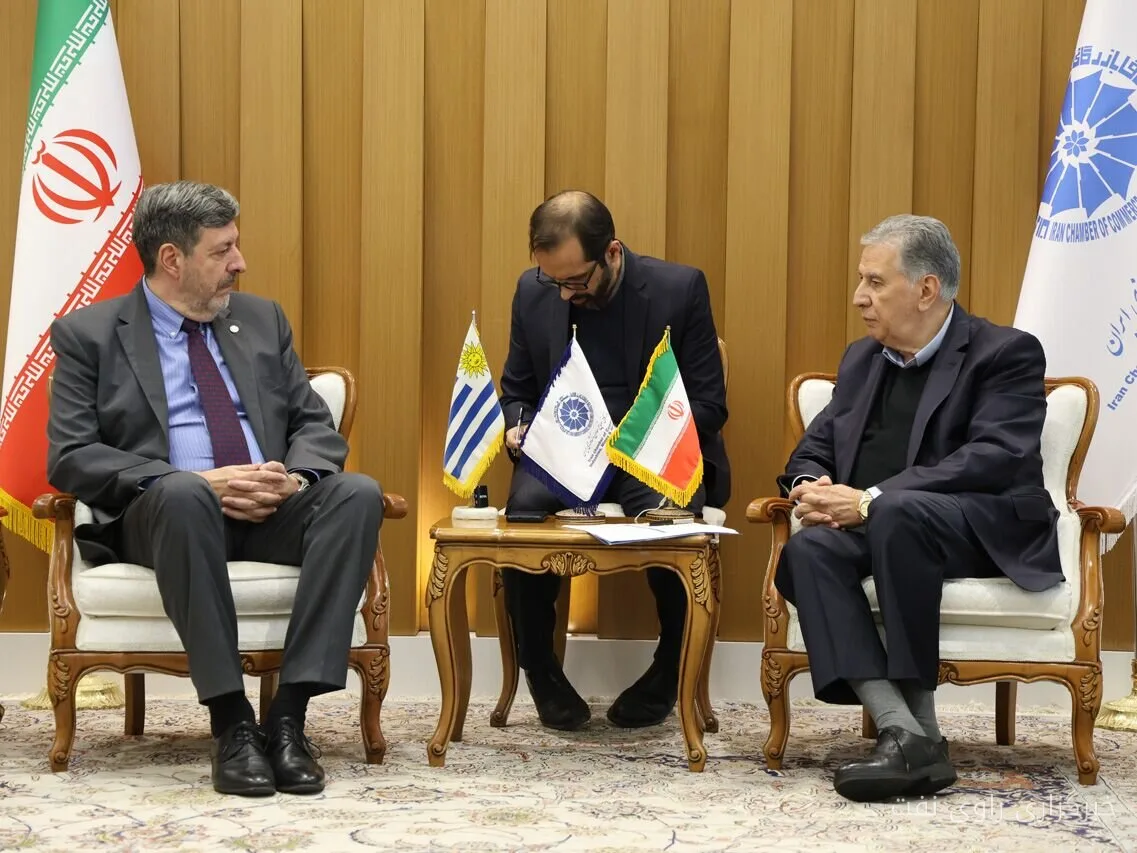
Samad Hassan-Zadeh, President of the Iran Chamber, discussed the economic and industrial capacities of the two countries during a meeting with Belardo Nicola, the Uruguayan ambassador in Tehran. Hassan-Zadeh emphasized the existing capabilities in Iran, mentioning suitable areas such as engineering services, modern petrochemical technologies, refinery, and agriculture that can help strengthen bilateral relations.
Iran's Export Capacities to Uruguay
The President of the Iran Chamber noted that the country's industrial capacities, including the production of parts and industrial machinery such as loaders, tractors, and combines, could aid exports to Uruguay. He also mentioned the possibility of exporting agricultural products, leather, shoes, and various pharmaceutical products to this country, adding: "By relying on these areas, we can develop the level of relations between the two countries, which is currently very limited."
Read more: The price of natural gas in the United States reached its highest level in the last three weeks
Hassan-Zadeh further referred to issues related to bilateral trade, stating: "The import of rice and meat from Uruguay to Iran and the export of urea, ammonia, and various fertilizers from Iran to Uruguay are examples of past collaborations that need to be reactivated." He emphasized the necessity of reviving these exchanges and said: "The conditions are ripe for defining the necessary mechanisms in this regard."
Memorandum of Understanding and Increasing Cooperation
The President of the Iran Chamber also announced the readiness of this institution to strengthen bilateral relations and create a framework for establishing relations between economic actors from both sides, stating that there is also the possibility of welcoming a trade delegation from Uruguay. He referred to a memorandum of understanding that was previously signed to create a joint committee between the two countries and considered its implementation effective for economic relations between Iran and Uruguay.
In another part of his remarks, Hassan-Zadeh emphasized the importance of maintaining values and international communications, saying: "The Islamic Republic of Iran does not seek war and conflict, and the success and well-being of all nations are respected by us." He also stressed the need for effective and continuous communication between the Uruguayan embassy in Tehran and the Iran Chamber, stating: "This communication can facilitate the necessary coordination for interaction between economic actors from both sides."
Belardo Nicola, the Uruguayan ambassador in Tehran, also referred to the high level of culture and history of Iran and spoke about efforts to strengthen relations between the two countries. He expressed hope that Iran would soon overcome the current complex conditions and that opportunities for cooperation would be created. Nicola also mentioned the interest of Uruguayan traders in collaborating with Iranian economic actors, stating: "The Uruguayan economy operates with a focus on the private sector, and we are exploring areas of cooperation."
Read more: A 49-point increase in the Baltic Index on November 9, 2026 · Stability and weakness in iron ore prices and steel production in China