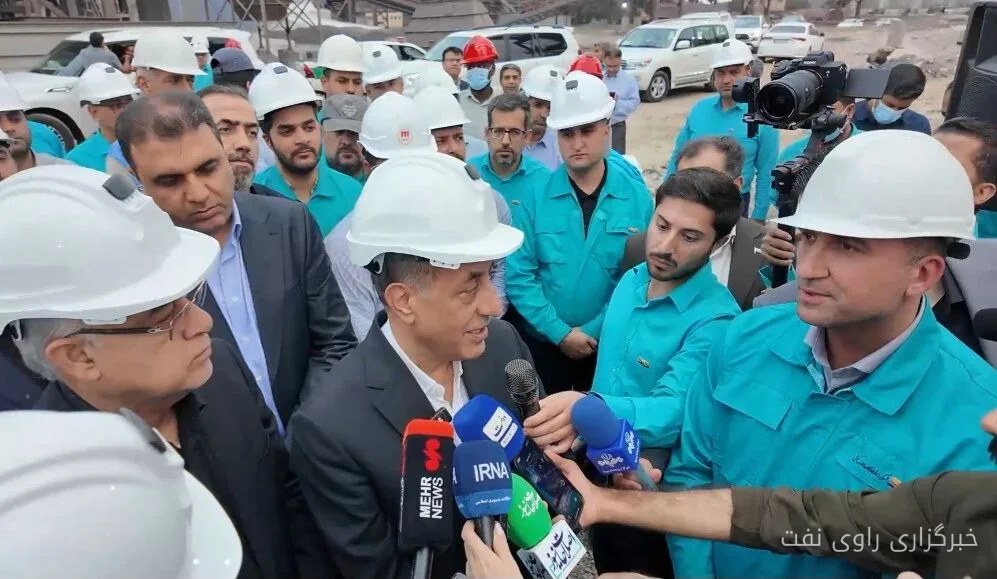
Mohammad Jafar Ghaempanah today (Wednesday, November 10) pointed to the increasing gas imbalance in the country during a visit to the Kaveh Steel Development Project and stressed the necessity of managing household consumption to prevent the halt of industrial activities and maintain workers' employment. He said: "Unfortunately, 230 million cubic meters of the country's gas capacity is damaged daily, and our colleagues in the oil industry are working to return 130 million cubic meters of this capacity to the production cycle."
The Necessity of Managing Gas Consumption
Ghaempanah emphasized the necessity of managing gas consumption in various sectors and added: "We hope that people will also reduce household consumption so that we can supply the gas needed for industries." He continued: "Supplying gas to the household sector, especially as northern cities are facing severe cold and snowfall, must be prioritized." Ghaempanah noted that industries should also help reduce gas consumption by utilizing efficiency methods and newer technologies.
Comparison of Iran's Gas Consumption with Other Countries
The Executive Vice President stated that the per capita gas consumption in Iran is high compared to many countries around the world, saying: "Our country's gas consumption is almost equivalent to that of China, which has a population of 1.4 billion." He added: "In terms of per capita gas consumption, Iran ranks first, indicating a high level of consumption in the country."
Ghaempanah emphasized that the highest level of gas consumption is related to the household sector, reminding: "If we can control household consumption this year with the management of the people, it will be a great help to industries so that workers do not become unemployed and industrial units do not cease operations."
He continued: "This issue also helps people's livelihoods; because when production stops, supply decreases, and in conditions where demand still exists, inflation naturally occurs."
The Executive Vice President, referring to the gas imbalance situation in the country, said: "Last year we faced a gas imbalance of 300 million cubic meters, and this year an additional 230 million cubic meters has been added, bringing the total imbalance to 530 million cubic meters."
Ghaempanah explained the amount of gas consumption during peak cold days, stating: "During peak cold, we consume about 900 million cubic meters of gas daily, of which about 650 million cubic meters is related to the household, commercial, and small industries, and nearly 300 million cubic meters is consumed in power plants and industries."
He emphasized: "If we do not manage resources and consumption, we will have to limit one of the household gas supply, power plant operations, or industrial activities."
Ghaempanah once again requested the public to help control the gas imbalance by managing their consumption so that such a large industry does not come to a halt and workers can continue their activities. He also considered production as one of the ways to increase the country's resilience against sanctions and said: "Production and increasing people's resilience is a form of fighting against economic warfare."