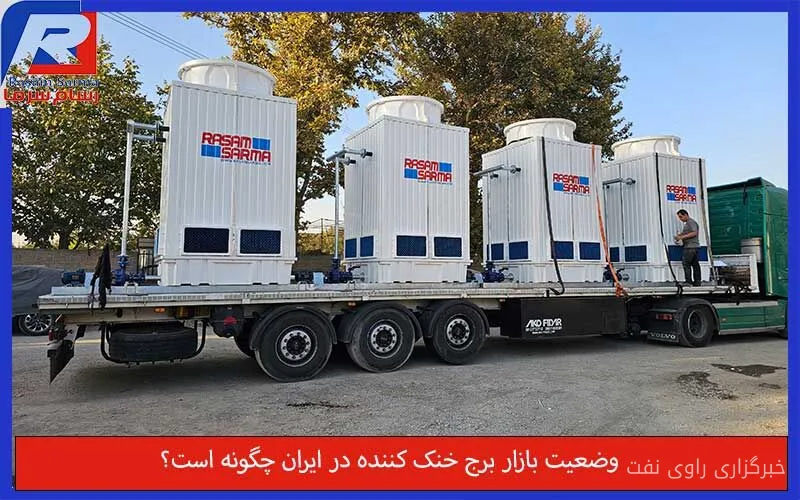
The cooling tower market in Iran is not limited to the sale of installation equipment; rather, it acts as a key component in the thermal processes of various industries. This equipment plays an important role in heat dissipation in industrial units, power plants, petrochemicals, and refineries, and is influenced by changes in industrial investment, energy costs, water resource limitations, and the development of production units.
Maintenance and Repair of Cooling Towers
The Iranian market is not limited to the purchase of new towers. Repair, refurbishment, replacement of packing, fans, and nozzles, as well as upgrading old towers, are considered part of market demand. According to data from an industrial database, in 1403, 140 production licenses were registered for cooling tower production, of which 106 units have operating licenses and 34 units are under construction. Although this statistic does not mean that all units are operating at full capacity, it indicates the domestic production capacity in this field.
Demand and Price Analysis
Demand for cooling towers in Iran comes from several different markets. For example, a manufacturing plant may need small or medium towers, while petrochemical complexes and power plants require cooling systems with much higher capacities. Therefore, the market cannot be measured solely by the number of units sold. Thermal capacity, climatic conditions, and specifications of industrial projects also play a significant role.
In refineries and petrochemical complexes, heat dissipation is part of the production process. Various equipment and heat exchangers transfer heat to the water circuit, and the tower is responsible for dissipating this heat into the environment. In such projects, the selection of a cooling tower is not based solely on nominal capacity; the quality of water, corrosion, and environmental conditions are also very important.
Power plants, as one of the key consumers of cooling systems, use different equipment for heat dissipation depending on their design and cycle type. Steel production processes and mining industries also come with high thermal loads, making material selection and maintenance planning particularly important in these areas.
Challenges of Water and Electricity Consumption
Evaporative cooling towers consume part of the water for heat dissipation. Therefore, in areas facing water resource limitations, managing water consumption becomes even more critical. Employers may resort to solutions such as precise blowdown cycle control and improving water quality. As a result, the issue of water has become one of the important factors in decision-making regarding cooling systems.
Additionally, the electricity consumption of fans and pumps constitutes part of the operating costs of the system. In industrial projects, attention to motor power, speed control, and fan design becomes more significant. For instance, a cooling tower in Tehran and one in Bandar Abbas do not necessarily have the same design conditions, and temperature and incoming air conditions can affect the actual capacity of the tower.
One of the frequently asked questions in the market is the price of this equipment. The price of a cooling tower depends on various factors such as capacity, body material, and type of fan, and a single price cannot be determined for all models. Therefore, when inquiring about prices, providing accurate technical specifications by the buyer is essential.
The existence of a significant number of licensed production units indicates that the Iranian market is not solely dependent on imports, and domestic production can offer many advantages, including easier access to parts and the ability to manufacture according to project specifications. However, the quality of design and construction remains highly important, and the domestic nature of the product alone cannot guarantee its proper performance.



