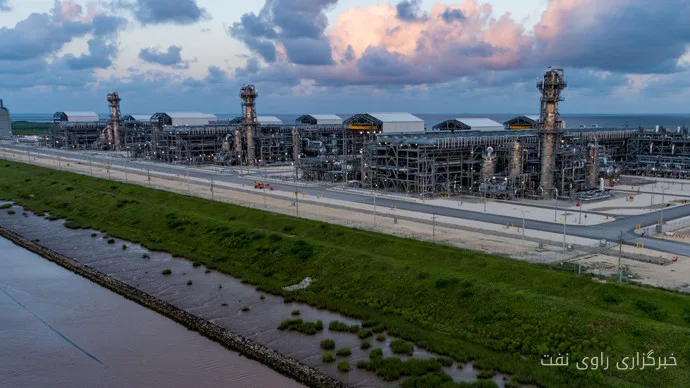
Xi Jinping, the President of China, traveled to Washington on September 24 to discuss the revival of the annual $6 billion liquefied natural gas (LNG) trade with the United States. This agreement is conditional on the removal of China's 15% tariff, which has prevented American gas from entering the Chinese market since the beginning of 2025.
Impact of Iran's Attacks on Qatar's Export Capacity
In March, Iranian missile attacks destroyed 17% of Qatar's LNG export capacity, and China was able to compensate for this blow by purchasing from other countries. According to data from Banchero Costa, Australia supplied 36% of its LNG imports from this country between January and July 2025. Other regions such as Southeast Asia accounted for 20%, Russia 12%, and Canada 4% of imports. Meanwhile, imports of liquefied natural gas from the U.S. were only 0.2%.Read more: The Role of Oil in Shaping Tomorrow with New Projects in the South Pars Gas Field
The 15% tariff imposed by China in February 2025 led to a drastic reduction in U.S. LNG exports to China from 64 ships in 2024 to zero in 2025. At its peak in 2021, U.S. LNG imports to China accounted for 12% of the country's total imports, valued at $6.2 billion. However, none of the major contracts were canceled, and Chinese buyers adhered to them, but instead of paying the tariff, they sold the shipments to Europe and Asia.
New Contracts and Future Prospects
China Gas Holding signed a 20-year contract with Venture Global on September 14 to purchase 500,000 tons of LNG per year, with deliveries starting in 2030. This volume covers less than 1% of China's total LNG imports of 68.43 million tons in 2025. However, Washington views this contract as a sign of nearing a tariff agreement. Yet, the contract itself does not set any conditions for tariffs, and there is no obligation for it.China Gas has secured supply without committing to import even a single shipment under the current tariff regime. Chinese companies have purchased nearly 25 million tons of U.S. LNG annually since 2018 and have signed long-term contracts of 20 to 25 years. Meanwhile, major forecasters have reduced their outlook for China's LNG demand in early 2030 to between 14 and 22 million tons, indicating a shift in China's approach towards pipeline gas and renewable energy.
Discussions in Washington and Beijing are ongoing regarding tariff reductions on about $30 billion of exports from both sides, including LNG. However, reducing tariffs would revert trade valued at $6.2 billion in 2021 to a market that no longer resembles that of 2021. During the tariff years, China has focused on building supply relationships with Australia, Southeast Asia, Russia, and Canada.
Read more: Ghasemali Bazayi Appointed CEO of the Pars Special Economic Energy Zone Organization · Revival of China's Steel Sector Following Request from the China Iron and Steel Association